
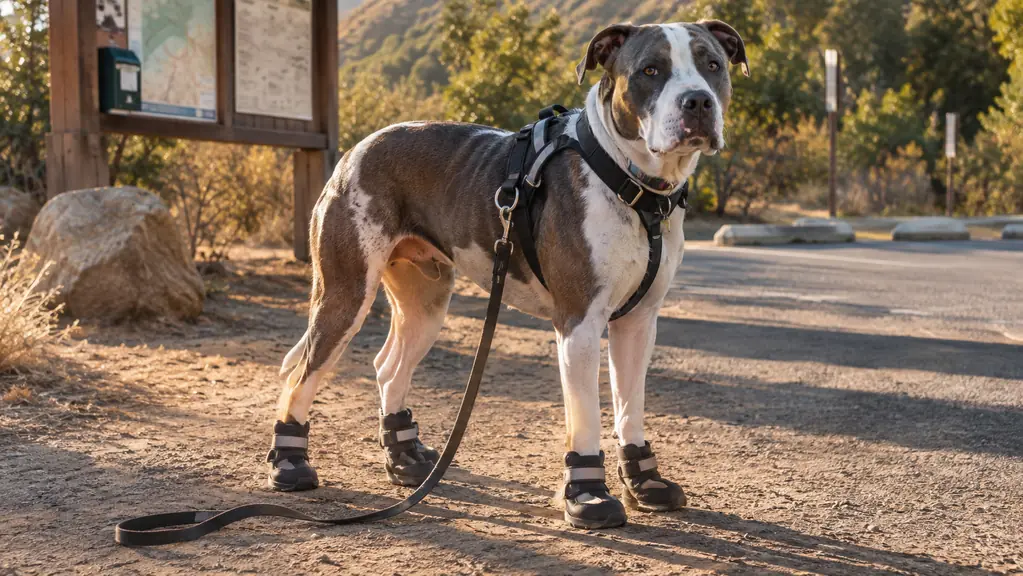
The first hot Saturday in June, I crouched at the edge of the agility club parking area and put my palm flat on the asphalt for a two count. Then I pulled it back. That is the test I use now, and it has called off more trail days than any training problem ever has. Juno is a four year old Border Collie, about forty pounds, and she has no off switch. She will fetch until her shoulders are sore and her pads are raw, and she will not mention either one until we are home and she is limping across the kitchen floor.
So a few months back I ordered a set of QUMY dog boots, the model sold as hot pavement shoes and snow boots and general paw protectors, in size 7. Before that I had tried the balloon style booties that vanish in tall grass and the little sock wraps that survive about one lap around the yard. I wanted a real sole under her. What follows is what has held up on foothill granite and club field asphalt, what has not, and the one step that decides whether these QUMY boots work for your dog at all.
The Quick Verdict
A rubber soled boot that stays on through a canicross mile on a pulling dog. It rewards careful measuring and it punishes a guess.
Amazon Check Today's Price →The pair that got Juno through a Boise July
Measure the widest part of the paw with the dog standing, then match that number to the size chart. Get that right and the closures do the rest.
Amazon Check Today's Price on Amazon →How I've Used It
We run canicross two or three mornings a week on the foothill trails east of town, and Juno does agility work at the club field most weeks. The field parking is asphalt that holds heat well past six in the evening in July and August. The same lot ices over in January. So the boots have done double duty for us: heat protection in high summer, and a barrier against frozen ground in winter. That is more use than I expected from a set of four shoes and an instruction manual.
The routine is short. Boots go on in the hatchback with the tailgate up, one paw at a time, closures pressed down snug. Then we walk on grass for a few minutes before I ask for any speed, because I want to see whether a boot is going to rotate before we are a half mile from the car. I check all four at the trailhead, again at the turnaround, and once more before we drive home. That is the whole system.
What I have not done matters too. I have not run these on a dog that panics at having its feet handled, and I have not left them on for more than about ninety minutes at a stretch. Heat builds inside a closed boot and so does friction, and a boot that rubs at mile one is a real problem by mile four. If your dog is new to boots, the first week is a two minute session in the living room, not a trail run.
Before the boots, I tried two cheaper routes. The balloon style booties were fine on packed dirt and gone within a hundred yards in the cheatgrass along the lower trail, and I spent one evening backtracking a switchback looking for one. The sock wraps stayed put better but wore through at the toe in about three weeks of club field work. Both were fabric against hot ground. Neither had a rubber sole under it, and that is the difference that finally made me stop looking.
Sizing Is the Whole Job
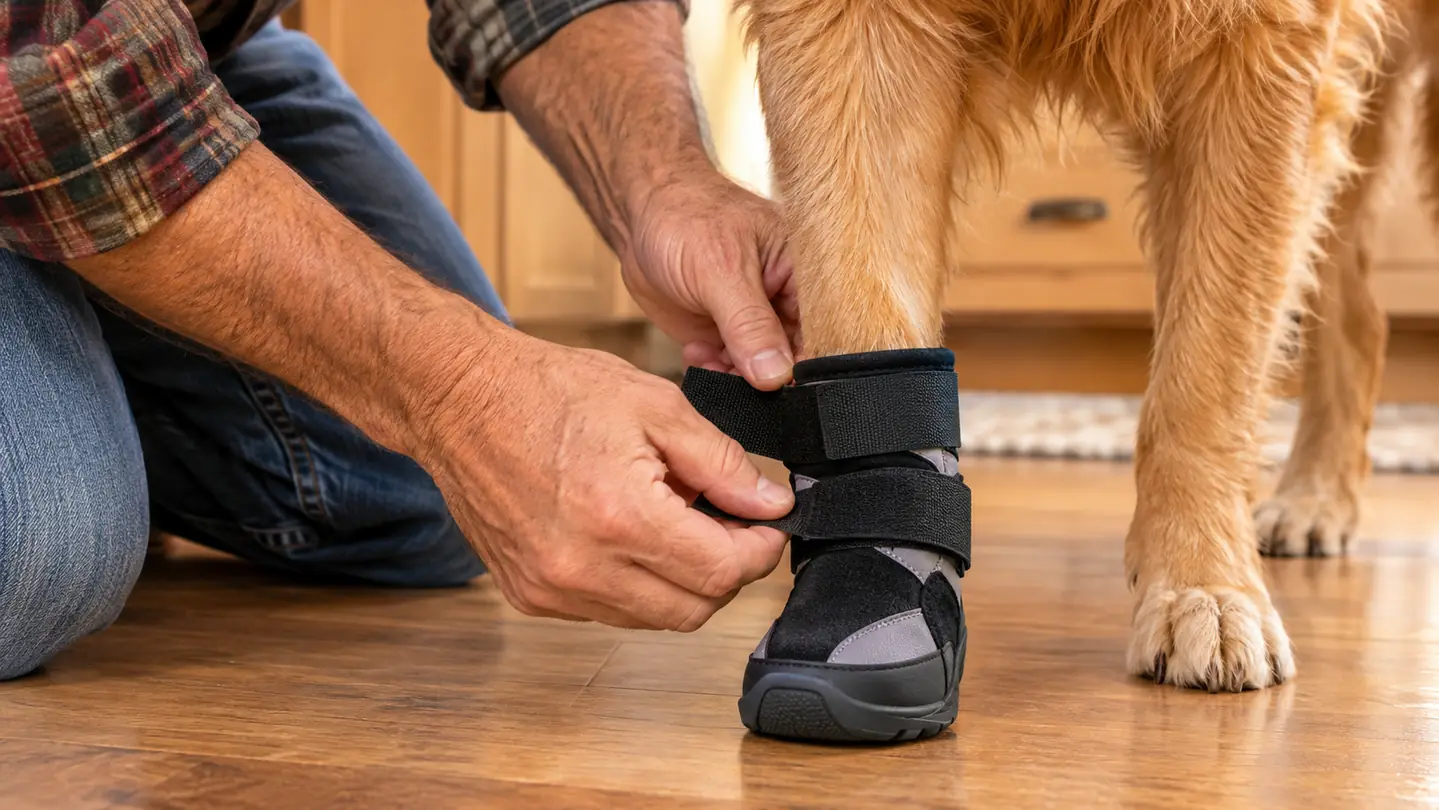
QUMY asks you to measure paw width instead of guessing by breed, and the listing leads with that instruction. Size 7 is listed at 2.8 inches wide by 3.2 inches long, and the set of four weighs 7.04 ounces. That is the entire fitting system. There are no half sizes and no custom mold, so the measurement you take is the fit you get.
I stood Juno on a sheet of paper and marked the widest point of each paw while she was bearing weight, because a paw spreads when it takes load. Her front paws came in just under 2.8 inches. The rear paws ran a little narrower. Front feet carry more of a running dog's landing force, so I fit to the front and let the rear closures take up the slack.
I measured three times over two days before ordering, because Juno was due at the club field that Saturday and I did not want to spend it on the sideline. The first reading I took while she was lying down, and it came out an eighth of an inch narrower than the standing measurement. Lying down is the wrong way to do it. Weight on the paw, standing square on the paper, is the only reading that matches the size chart, and an eighth of an inch is enough to decide whether the shell sits flat or pinches at the outside toe.
If your dog lands between sizes, that is the decision point. A boot that is too narrow will rub the outside toes, and you find out about it after the fact, because a high drive dog will keep running on a hot spot until you stop her. I would rather run slightly roomy and cinch the hook and loop closures down than squeeze a paw into a shell that measures right on the line and no further.
On Hot Asphalt and Rough Trail
The sole is the reason I kept using these. It is a real rubber sole with a tread pattern, described by QUMY as slip proof and built for rough terrain, and it puts a layer between Juno's pads and whatever she is standing on. On the chip seal path near the trailhead it holds well. On the granite slabs that cross our usual loop it holds less well, and I slow her down there. That is less a knock on the boot than a fact about smooth wet rock.
On hot asphalt it does the job I bought it for. I keep an infrared thermometer in the car, and I have watched that club lot read 138 degrees in mid July. With the boots on, Juno is standing on rubber and fabric instead of on that surface. Fifteen minutes on that lot without them and she is lifting paws and shifting her weight from foot to foot, which is the only complaint she knows how to make.
The upper is a mix of faux leather, nylon and polyester with silicone in the construction, according to the listing, sewn to the sole. It is not a breathable mesh. After a hard summer run the inside is damp and her pads are warm, so I take them off as soon as we are back at the car rather than letting her ride home in them. In winter that same closed construction is exactly why they work, because frozen ground stays off her pads.
The other thing I watch is duration. A boot does not cool a paw, it only separates the paw from the surface, and heat still comes up through a rubber sole given enough time. On the hottest days I shorten the run and move us onto the shaded side of the trail rather than trusting the boots to buy unlimited minutes. Twenty minutes on that hot lot with boots on is a very different thing from an hour. The boots widen the window. They do not remove the need to put your own hand on the ground first.
Grip on ice is decent but it is not a studded solution. On a shaded patch of trail that has frozen solid, the tread bites enough for a controlled walk and not enough for a hard pull. I also keep her on a short line for the first quarter mile of any winter run, because the boots protect her pads from the cold but they do not change how a dog reads frozen ground. No boot replaces judgment about the surface you are asking your dog to run on.
Months of Wear: An Honest Ledger
Three months of regular use, and here is the honest account. The soles are intact. The tread has worn visibly smooth at the outer push off edge of both front boots, which is exactly where you would expect a running dog to wear a sole first. The hook and loop closures still grab, though the loop side has collected enough fine trail dust that I have to scrape it with a thumbnail before it holds properly.
I keep a note on my phone for gear like this, mostly so I stop arguing with my own memory. The log says the boots went out on thirty-one runs between early June and the end of August, plus a handful of club field evenings. The two front boots carry the most wear by a wide margin, which tracks with how a running dog lands. If I were replacing them today I would order one set and swap the front and rear boots every other run, which costs nothing and spreads the wear across four soles instead of two.
One seam on a rear boot began to separate at the toe around week ten. Not a hole yet, and not on a paw that takes the heaviest impact, but I am watching it and I have started checking that seam with a thumb before every run. A split toe seam on a front boot would end that boot for trail use, and I would not pretend otherwise just because the rest of the set is fine.
Cleaning instructions say hand wash only, and that is not a suggestion. I put one pair through the washing machine on a gentle cycle early on, out of laziness, and the faux leather came out creased and stiff and never sat the same on the paw again. Cool water, a soft brush, air dry away from direct sun, and the boots come back to shape. Ten minutes for a set of four.
There is no warranty. QUMY's listing states the warranty description as no, plainly, so you know what you are getting going in. That is the real tradeoff. If a seam splits at week ten, you are not filing a claim, you are deciding whether to order another set. A boot from a brand with a replacement policy will cost more and will stand behind the stitching. This QUMY boot does not, and pretending otherwise would be dishonest.
What I Liked
- A real rubber sole with tread, so the paw is off the hot surface instead of wrapped in fabric
- Hook and loop closures hold through a canicross mile on a dog that pulls
- Set of four with a stated measurement of 2.8 inches wide by 3.2 inches long in size 7, rather than a breed guess
- Works across the year, covering hot pavement in summer and frozen ground in winter
- Light enough at 7.04 ounces for the set that Juno's gait did not change on the first run
Where It Falls Short
- No half sizes, so a dog that lands between sizes will be running with the closures cinched down
- The upper is not breathable and paws come out damp after a hard summer run
- No warranty listed, so a split seam is a replacement decision, not a claim
- Hand wash only, and one machine wash on a gentle cycle left the faux leather stiff
- Tread wears smooth at the push off edge of the front boots after a few months of hard use
Three months in: soles intact, one toe seam going, closures still holding at a dead run. That is a fair trade for a boot that comes with no warranty at all.
Getting Them On a Dog That Will Not Stand Still
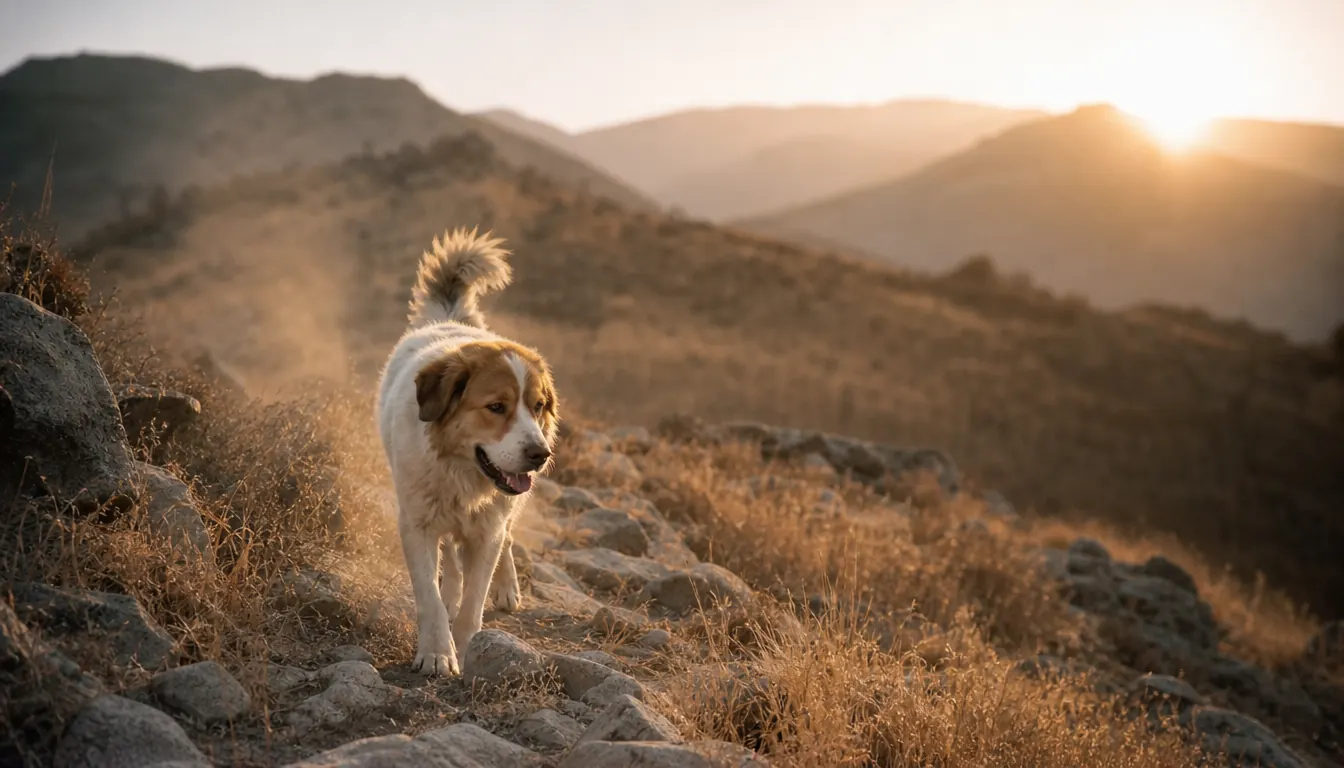
Juno does not stand still, and this is where the closures matter more than the sole. The hook and loop strap opens wide enough to get a paw in without forcing anything, and it presses down with one hand while the other hand keeps her from walking off. On a wet or dusty strap I wipe the loop side on my pants leg first, because a dirty closure is the most common reason a boot comes off mid run. Fine grit works into the loop and the hook has nothing to grab, and I learned that on a January morning when a rear boot came loose a quarter mile from the car.
Two people make it easier and one person can do it in about a minute once the dog knows the routine. I put the boots on before the leash comes out, not after, because Juno's brain leaves the building the moment she sees the leash. And I reward with a treat after the fourth closure, every single time, which is the only reason she now stands for it at all.
Who This Is For
This is for the owner of an active dog who needs a barrier between paws and a surface, not a fashion accessory. If you run summer pavement, hike decomposed granite, or deal with frozen ground through the winter, a rubber soled boot does something a sock wrap cannot. It suits a dog that tolerates its feet being handled for a minute and an owner willing to measure a paw properly before ordering. Juno is a forty pound high drive Border Collie, and size 7 has been the right shell for her front feet with the rear closures cinched down a little more.
Who Should Skip It
Skip it if your dog will not have its feet touched. No closure system fixes that, and you will be wrestling a boot onto a dog that is already stressed. Skip it if you need a guaranteed fit for a dog that sits between sizes, because there are no half sizes here. Skip it if you want a warranty behind the stitching, or something you can throw in the washing machine. And skip it if you need traction on hard crusted ice on steep ground, because this tread is not a studded sole. For everything short of that, the QUMY boots have earned their spot in the hatchback.
Measure the paw, then decide
Three months of foothill miles with one seam to watch and soles still intact. If the width measurement lines up with your dog, that is a straightforward yes.
Amazon Check Today's Price on Amazon →