
Three of the four QUMY dog shoes came home from a September trail run still on Juno's feet. The fourth is somewhere in the foothills east of Boise, and I know exactly which stretch of loose rock took it. That is the honest shape of this review. The question is not whether the boots are worth owning. It is which part of them fails, when it fails, and whether you can plan around it.
Juno is a 4-year-old Border Collie, about 40 pounds, extremely high drive, the kind of dog who will keep fetching until I physically stop her. I have run her in boots for two years: July pavement, crushed rock on the Greenbelt, the icy driveway that turns into a skating rink every January, and a lot of grass at the local agility club field. This is a review of the QUMY set specifically, written for the owner who already lost a pair of dog boots in the first hundred yards and wants to know whether these behave any differently.
The Quick Verdict
Grippy on hot pavement and flat trail, light enough that a 40 pound dog forgets them, and honest about its limits. The hook and loop closure is the wear item, and a loose fit will cost you a boot.
Amazon Check Today's Price →The boot that lives in my hatchback from June to September
It is not the boot I race in. It is the one I keep by the tailgate for hot asphalt, flat trail, and the walk I would otherwise skip because the pavement is too hot. Measure the paw width first, then order.
Amazon Check Today's Price on Amazon →How I Actually Tested Them
We logged 38 outings in the QUMY boots between June and October, roughly 90 miles of mixed surface. Nineteen were pavement walks in heat, twelve were foothill trail runs on decomposed granite, four were the agility field, and three were carryover days on packed snow from the last storm. I measured Juno's front paws standing, weight on, at 2.75 inches wide and just over 3.1 inches long at the tip of the longest claw.
That put her in Size 7, listed at 2.8 inches wide by 3.2 inches long, four shoes to a set. The whole set weighs 7.04 ounces on my kitchen scale, light enough that she quit noticing them by the second outing. I did not use the weight chart. The listing says it outright in its first bullet: measure the width of the paw carefully, because weight can mislead you. I have watched two friends order by breed size and end up with boots that spun on the paw within a block.
The test protocol was boring on purpose. If a boot moved, I stopped, reset it, and wrote down the surface. If it came off, I wrote down the surface and the gait. Sprinting after a ball, trotting on flat asphalt, and downhill trail running load a boot in three different ways, and the failures cluster instead of scattering.
I also ran the same loops barefoot on cool mornings as a control, so I could tell whether a change in Juno's gait came from the boot or from her. That is the part most reviews skip, and it is the part that told me the most about where these earn their place.
The Sizing Problem Nobody Warns You About
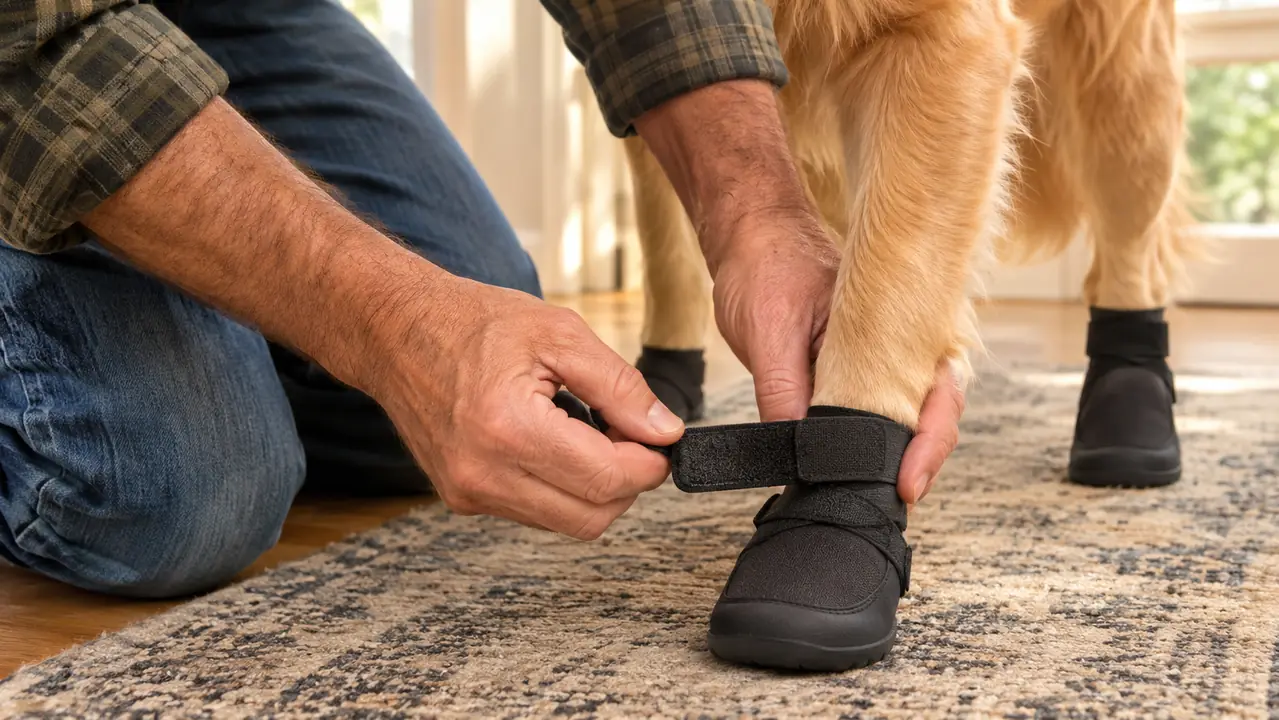
The biggest reason these get sent back is not the boot. It is the measurement. QUMY's first bullet tells you to measure paw width and warns that weight misleads, and that is the most useful sentence in the listing. A 40 pound Border Collie and a 40 pound blocky mix do not wear the same size, and a breed chart will not save you.
Measure with the dog standing on all four paws, because a paw spreads under load. Include the claw in the length. Juno's front left is 2.75 inches wide. Her back paws run close to a quarter inch narrower, which matters because the boots do not come in a front and back cut. She wears Size 7 on all four and the backs sit slightly loose. That looseness is what cost me the fourth boot on a downhill sprint.
There is a narrow window where the fit is genuinely good. Too big and the paw slides inside, which rubs the top of the toes and lets the boot rotate. Too small and you will see the dog high-stepping or planting and refusing within a minute, which is a clear enough signal if you are paying attention. Size 7 was right for Juno at the front and about a half size generous at the back.
If you are between sizes, take the smaller one and check the paw after ten minutes. A snug boot that rotates slightly is easier to fix than a loose boot that is coming off, because you can adjust the closure. You cannot shrink the upper.
The set arrives with four shoes and one instruction manual, and the manual is worth the ninety seconds it takes to read. It covers the measuring method and the introduction sequence, and both are the parts people skip right before they decide the product does not work.
What the Hook and Loop Closure Does After Forty Outings
The closure is hook and loop, and the listing calls it secure and adjustable, which it is for the first twenty outings. Here is what nobody tells you: hook and loop is a wear item on a dog boot in a way it is not on a jacket. Grit works into it. Snow works into it. By outing thirty I was picking decomposed granite out of the hook side with a key before every walk.
A clogged hook side still holds, just less. That is the honest failure curve. The boot does not pop off on flat ground. It starts rotating a few degrees on hard turns, and once it rotates it walks itself loose. The fix is unglamorous: brush the hook side with a stiff brush after gritty outings and it comes back to nearly new. Skip that and you are on a clock.
I will also say plainly, because it surprised me, that these are not a boot I would trust on a hard canicross pull. On a slack line at a trot they are fine. Under real tension, with the dog driving forward and the paw loading sideways, the closure takes load it was not built for. For a pulling dog I would want a different retention system entirely, which is most of what the comparison against a dedicated trail boot comes down to.
Putting them on takes maybe fifteen seconds per paw once the dog stands still, and Juno gets a hand target and a piece of chicken for each one. Four paws, four rewards, done. The first week was slower and involved a lot of sitting on the kitchen floor.
Getting Them On a Dog That Does Not Want Them On
Nobody warns you that the boot is the easy part and the dog is the hard part. Juno was already used to having her paws handled from agility contacts and nail trims, so I had a head start. A dog that has never had anything on its feet will usually lift the paw, shake it, and then walk like the floor is lava for about ninety seconds.
What worked was four sessions on carpet with no walk attached. Boot on, treat, boot off. Then one boot for a short hallway walk. Then two. I would not put a full set on a dog for the first time on hot pavement, because if the dog panics you now have a heat problem and a fear problem at the same time, which is a much harder week.
Grip on Pavement, Wet Rock and Snow
The sole is the reason to buy these. It is a rubber and silicone sole that QUMY describes as slip-proof and rugged, and on hot asphalt and flat trail it does what it claims. In July I can hold my palm flat on the Greenbelt for three seconds before it stings. Juno in boots trots across that same stretch without the mincing steps she does barefoot.
Wet rock is mid-pack. On damp basalt along the river they held better than I expected for a sole this flexible. On loose gravel over hardpack they pack up between the sole and the pad, and you can hear the change in the footfall before you see it. That is less a QUMY flaw than a limit of any lug pattern at this scale.
Snow is the surprise. The uppers are faux leather with nylon and polyester panels, so a light dusting sheds fine, but wet snow balls up in the tread the same way it does on a human boot without a coating. On a thirty minute wet snow outing I stopped twice to knock it out. Dry cold powder was a non-issue.
On the agility field grass, the boots were neutral, which is the best thing I can say. Juno turned and stopped on a contact obstacle without slipping and without adjusting her stride. Anything that changes how a dog moves on turf is going in the bin.
One caution that is not about the boot at all. Boots do not make hot pavement safe for a long outing. If the back of your hand cannot stay on the asphalt for five seconds, shorten the walk regardless of what is on the paws, and pick a shaded route.
Thirty-eight outings, one lost boot, and zero hot pavement refusals. That is the trade, and I would make it again.
Care, Drying and the Hand Wash Rule
The care instruction is hand wash only, and it exists for a reason. The upper is a stitched assembly of faux leather, nylon and polyester, and a washing machine will chew the stitching and wreck the hook side of the closure in one cycle. I wash mine in a bucket of cool water with a drop of dog shampoo, scrub the sole with a nylon brush, and rinse until the water runs clear.
Drying matters more than washing. Stuff the boots with newspaper and set them where air moves, not on a radiator and not in a hot car. Faux leather that dries too fast goes stiff at the flex point over the toes, and a stiff boot rubs. Mine are three months in with no seam separation, and I credit the drying more than the design.
What Wears Out First
Ranked by when it showed up: the hook side of the closure, then the tread at the outer heel edge on the two boots that see the most pavement, then the stitching where the upper meets the sole at the flex point. The sole has not worn through. The outer heel tread is visibly shallower than new after 90 miles, which is fair for a set that weighs 7.04 ounces total.
Nothing has ripped. Nothing has separated at a seam. The failure I actually experienced was retention, not construction, and it happened on loose downhill rock at a full sprint, which is the hardest thing I ask of any boot on any dog.
Worth noting there is no warranty listed on the product. That is not a dealbreaker at this tier, but it means care and maintenance are entirely on you, and a poorly dried boot is not getting replaced.
What I Liked
- Rubber and silicone sole gives real traction on hot asphalt and flat trail
- The full set of four shoes weighs 7.04 ounces, light enough that a 40 pound dog stops noticing them
- Hook and loop closure is genuinely adjustable and fits a range of paw widths
- Rugged stitched upper in faux leather, nylon and polyester survived three months with no seam separation
- Four shoes plus an instruction manual in the set, so one lost boot does not end the purchase
Where It Falls Short
- Hook and loop is the first thing to wear and clogs with grit and snow, needing a brush after gritty outings
- One size for all four paws, so a dog with narrower back paws runs slightly loose at the rear
- Not enough retention for a hard canicross or bikejor pull
- Wet snow packs into the tread and has to be knocked out mid-outing
- Hand wash only, no machine washing, no dryer, and no warranty listed
Where These Sit Against a Real Trail Boot
The honest frame is that QUMY is a paw protector, not a technical trail boot. That is not a knock. It is a different job with a different build, and the cost of admission is lower in every sense. If you want a boot for the Greenbelt in July and the driveway in January, this is a sensible first buy and I would hand it to a friend without hesitating.
If you are canicrossing twice a week on rocky terrain, the retention system and the sole construction are where you will feel the difference, and you will pay for it. My own split is a QUMY set in the hatchback for casual heat walks and a heavier boot for anything with real vertical or real pull. Both get used. Neither replaces the other, and anyone who tells you one boot does both is selling something.
The other thing to weigh is that a four boot set means one failure does not strand you. Most boot brands sell in pairs or fours, and if you run a dog that chews or loses things, having a spare on the shelf is quietly useful.
Who This Is For
This is the right boot for the owner of a large breed dog who needs paw protection on hot pavement, flat trail, the Greenbelt, or cold dry snow, and who is willing to measure properly and brush out the closure. It suits a dog that trots alongside on a slack leash and tolerates something on its feet. Juno's situation, an active dog on mixed surface in a hot climate with a genuine winter, sits close to the center of what these are built for.
It also suits the owner who wants a low-stakes first set to find out whether their dog will wear boots at all. If the dog refuses, you have learned that for very little and you can move on to a different approach. If the dog accepts them, you have a working set of four for the summer.
Who Should Skip It
Skip these if your dog pulls hard in a canicross or bikejor setup, if most of your miles are loose scree or deep wet snow, or if you want a boot you can put on and forget for a month without maintenance. Skip them if you are not going to measure the paw width, because a badly sized boot is a bad boot no matter who made it.
And skip the four boot set entirely if your dog will not tolerate anything on its feet after a fair introduction. Paw protection only works if the dog keeps moving normally in it. A dog that shuts down in boots on a hot sidewalk is worse off than a dog walked earlier in the morning with no boots at all.
Measure the paw first, then order the size you actually need
Size 7 is 2.8 inches wide by 3.2 inches long, four shoes to a set, hand wash only. If the width lands between sizes, take the smaller one and check the paw after ten minutes.
Amazon Check Today's Price on Amazon →