
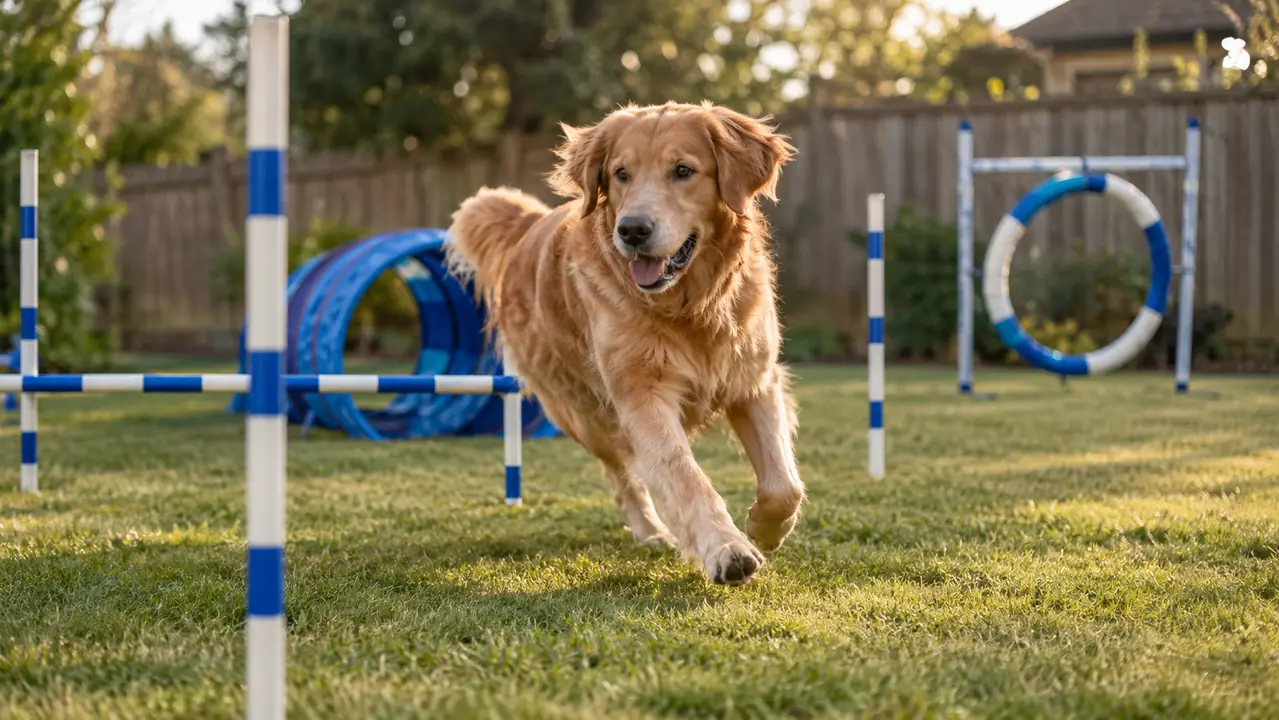
Sixty pieces, and the shipping box weighs 8 pounds. That was the first honest thing the JMMPOO agility kit told me, before I had unfolded a single pole. Light gear is not automatically bad gear, but it does tell you what kind of kit you bought: this is a backyard starter set built to be carried out and put away, not a club course that lives in the ground all season. Once you know that, the rest of this review makes sense.
I compete in agility and canicross with Juno, my 4-year-old Border Collie. She is about 40 pounds, she has one speed, and she would rather work than eat, which is exactly why I care more about pacing, paw care and recovery than I care about how many obstacles come in a box. When the JMMPOO kit arrived I set it up in my small fenced backyard outside Boise, ran it two or three times a week through a full spring, then broke it down and hauled it to the club field twice. Here is the part the listing photos leave out.
The Quick Verdict
A genuinely useful starter kit for a green dog and a small yard. Held back by light bases that shift on hard ground and a piece count that flatters the number of actual obstacles.
Amazon Check Today's Price →Three obstacles do the real work. See what the other pieces are for.
The collapsible tunnel, the adjustable hurdle and the eight weave poles are the training tools in this kit. Everything else is hardware and extras. Check the current piece list and today's price before you decide.
Amazon Check Today's Price on Amazon →How I Actually Used It
The first setup took about twenty minutes, and that was with Juno spinning in circles and standing on the pause box before I had finished laying the course out. There is no instruction booklet worth the name in the box. You get the parts, you get the photos on the listing, and you figure out the rest. The floor bars are the key to the whole thing: eight short bars at 12 inches with outside caps and four long bars at 22 inches with outside caps. Those are what give the uprights a footprint and hold the spacing that makes a hurdle a hurdle and a weave line a weave line.
My first attempt at the weave line was wrong in a way that took me a whole session to diagnose. I set the eight poles roughly two feet apart because that is what the listing photos looked like, and Juno popped out after the second pole every single time. I closed the spacing to about eighteen inches, walked her through on leash with a reward at each gap, and she was driving the entire line by the end of that week. Nothing in the box told me to do that. I got it from a club friend.
The second setup took eight minutes. The third took five. That learning curve is worth knowing about if you are buying this for a dog who cannot wait, because the first session will be mostly assembly and the second one will be the real one.
My yard is small. The listing gives overall product dimensions of 57.09 by 27.56 by 36.22 inches, and I laid the course out in a strip close to that along the back fence. It fit, which is the good news. The catch is that a tunnel, a weave, a hurdle and a pause box in a strip that size is a tight, low speed handling exercise. For a green dog that is ideal. Juno is not green, and she had the layout memorized by week three. That is partly a me problem and partly a kit problem, and you should know it before you buy.
Twice I folded the whole thing into the hatchback and took it to the club field, and that is where the kit makes the most sense. Everything collapses, everything goes in the storage bag, and the 8 pounds rides next to Juno's crate without me rearranging the back of the car. Setting up on a flat, mowed field instead of my lumpy lawn made the hurdle and the weave line noticeably more stable. If you have access to a flat field, use it.
One April morning at that field the wind came across the open side at maybe fifteen miles an hour, and I gave up on the jump ring entirely and ran tunnel and weave only. It was still a good session. That is the trade with light gear: you learn to work with the weather instead of fighting it, and you learn which two or three obstacles you can set up fast when the conditions are not doing you any favors.
What the 60 Pieces Actually Are
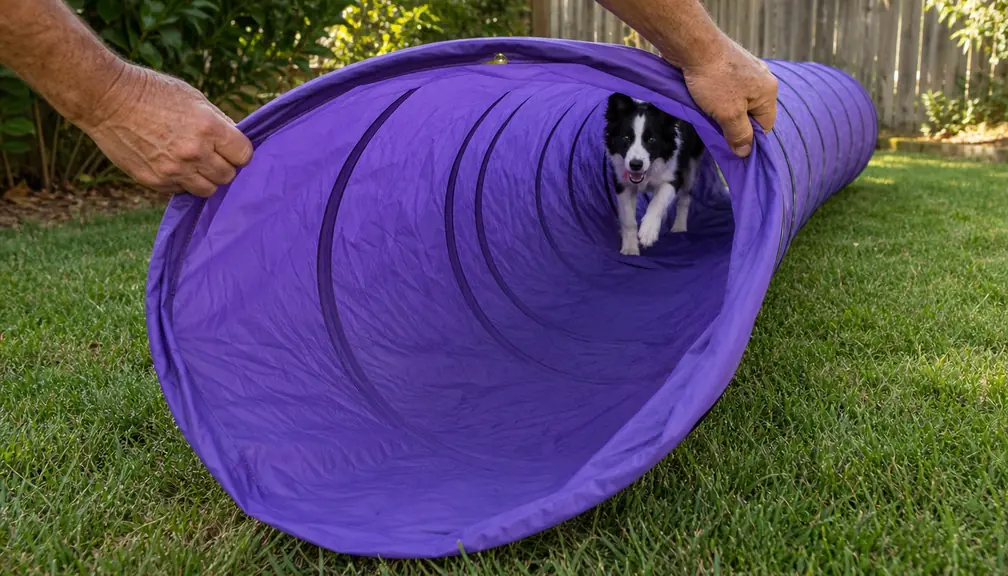
This is where the honest review has to start, because the number on the box is doing the heaviest lifting in the marketing. Sixty pieces is not sixty obstacles. The count is dominated by the poles, the floor bars, the outside caps and the connectors that hold the assembly together. What you actually get as obstacles is a collapsible tunnel, eight weave poles, an adjustable hurdle, a jump ring, a square pause box, a whistle, two pet tennis balls and a storage bag. That is a useful set. It is just not a big one.
If you are picturing a full course in your head, picture a third of it. The tunnel, the weave poles and the hurdle are the three that do real training work, and all three are here. The pause box and the jump ring round it out. The whistle and the tennis balls are the extras that end up at the bottom of the bag, and I say that with affection, because the tennis balls lasted about nine minutes in my house.
The tunnel is the piece I expected least from and it is the one that has held up best. It is 190T tear-resistant polyester, which reads like a spec sheet line until you watch a 40 pound Border Collie take a corner badly at full tilt and come out the other side with the fabric intact. Surface scratches, yes. A tear that matters, no. The collapsible design is what makes it useful, because a tunnel that folds flat into a bag is a tunnel you will actually bring places, and a tunnel that does not fold lives in your garage forever.
I have sent Juno through that tunnel something close to two hundred times since March, and the fabric has a dull scuff down one side where she drags her shoulder on the exit turn. That scuff stopped growing back in May. The thing I actually watch on any soft tunnel is where the fabric meets the opening, because that is where a dog catches a foot coming out hot. Mine is still sitting flat and flush, which is more than I expected from a kit this light.
The pause box is the piece that surprised me for a different reason. It is a square marked out on the ground, there is nothing to it, and it turns out to be the most useful thing in the bag for a dog who breaks her start. Two minutes of rewarding a settle in the box before every session has done more for Juno's start line than any amount of jump work. A box is only useful if you have taught a stay, so that part is on you.
Where the Kit Surprised Me
The adjustable hurdle is the piece I would keep if I could only keep one. Height adjustment matters for a young dog, and it matters for a dog coming back from a soft tissue issue, which in my line of work is a normal Tuesday. Being able to drop the bar to a stride height and bring it back up as confidence returns is a real training tool and not a novelty.
The weave poles were the surprise in the other direction. Eight poles is enough to teach an entry and a rhythm. It is not enough to teach a finished weave. If your goal is a competition-ready dog, this gets you to the doorway and not through it, and you will be buying more poles. If your dog has never seen a weave pole in her life, eight poles set in a gentle channel is exactly the right place to start, and I have used them that way with a friend's young dog at the club field.
Sixty pieces is not sixty obstacles. It is three good training tools and the hardware that holds them up.
What Nobody Tells You
Nobody tells you that this kit is a fair weather friend. That is not a knock on JMMPOO specifically, it is what happens when you build a course out of light components and set it on a lawn. A modest gust moves the weave poles and takes the jump ring down. On grass the whole assembly shifts a little under a hard turn. I have had a good session on a still morning and a bad one on a windy afternoon where I spent more time resetting poles than training. Check the forecast, or set up behind a windbreak.
Nobody tells you the storage bag is the second most important piece in the kit. Portability is the whole reason this thing exists. Everything breaks down, everything goes in, and the bag is what turns a pile of parts in your garage into a course you will actually use. Mine has been in and out of a car twenty times and the seams are still fine. If the bag had failed, I would have used this kit four times and written a much shorter review.
And nobody tells you the kit does not train the dog. You do. JMMPOO supplies the obstacles and the whistle. It does not supply handling, timing, reward placement or a plan. That sounds obvious until you watch a dog run the tunnel forty times in a row because the handler is having fun and the dog is just getting faster and sloppier. Agility is a precision sport and a starter kit is a set of props. The training is still yours.
What I Liked
- Tunnel fabric survived a full season of hard turns with scratches but no tears
- Adjustable hurdle covers young dogs, green dogs and dogs coming back from an injury
- Whole kit is 8 pounds and folds into the storage bag, so it actually travels
- Eight weave poles are enough to teach entry and rhythm to a beginner
- Pause box is a genuinely useful training tool for start line work
Where It Falls Short
- Piece count includes poles, floor bars, caps and connectors, not 60 obstacles
- Light floor bars slide and shift on hard ground and move in wind
- No useful instructions in the box, so the first setup is guesswork
- Eight weave poles is not enough for a competition-ready weave
- Tennis balls are a token extra and will not survive a driven dog
Durability After a Full Season
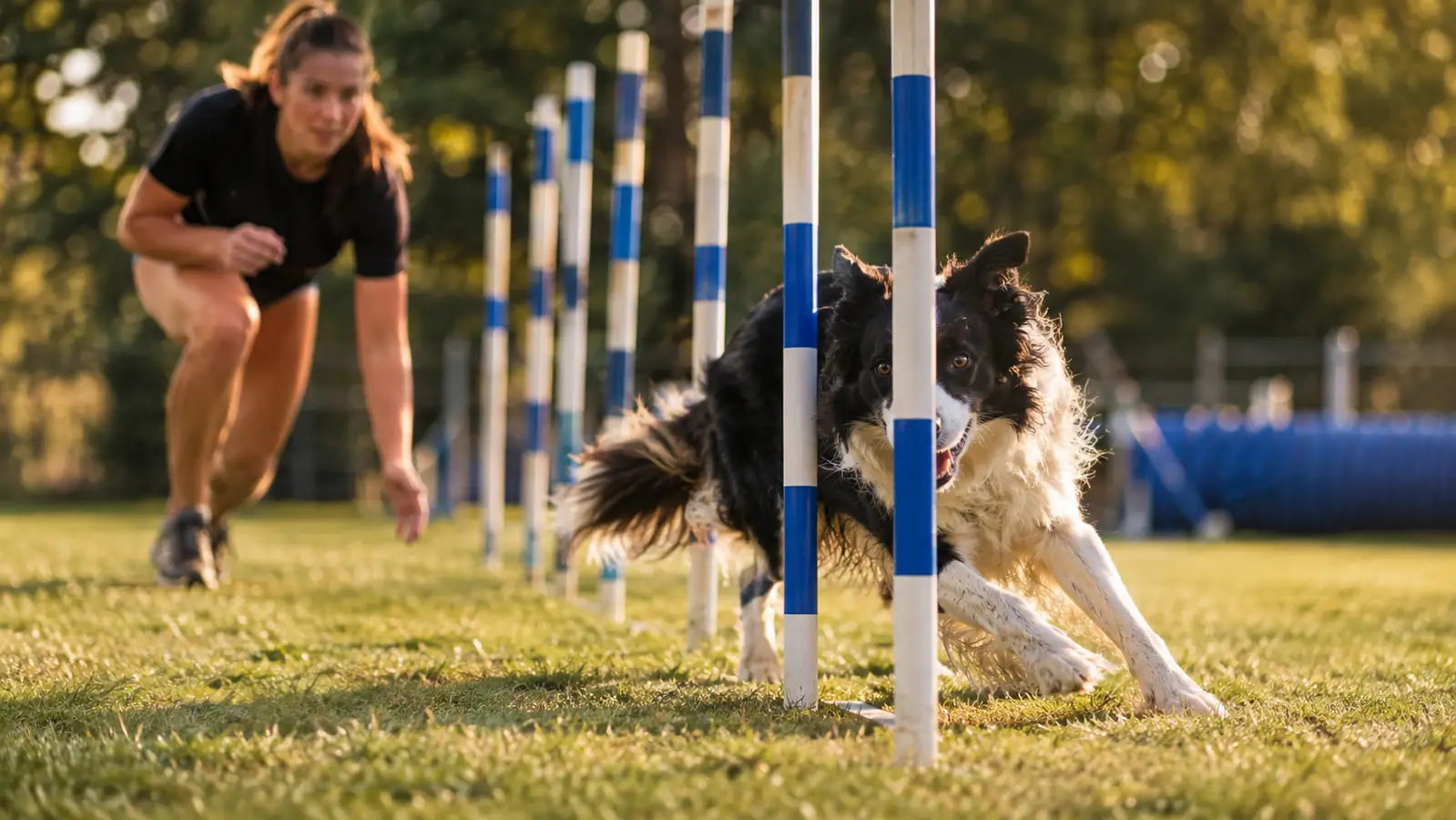
After a spring of two to three sessions a week, here is the wear report. The tunnel has surface scratches and no structural damage. The weave poles are scuffed where Juno's shoulder clips them, which happens on every field with every pole. The outside caps on the floor bars are still seated, which is better than I expected from a light kit. The whistle still works and I still cannot get a reliable recall on it, and that is a training gap on my end, not a product failure.
By June the caps on two of the twelve-inch floor bars had worked loose enough that I could spin them with my thumb, and I pushed them back down by hand. They have stayed put since. That is the sort of thing that separates a light kit from a heavy one over years rather than months, and I will be checking those same caps again next spring before I trust the hurdle on a hard turn.
The floor bars are the part I would watch over a second season. Light bars on grass are fine. Light bars on a hard surface slide, and a sliding base under a hard turn is how a dog loses a stride and how a handler loses a knee. I run mine on lawn and I do not set the hurdle on concrete. If your only flat space is a driveway, budget for a mat or expect to chase the course around.
Safety Notes I Would Give a Friend
Before any of this, check the ground. A backyard in July in Idaho is hard and dry, and hard dry ground is unforgiving on a dog landing from a jump. I water the lawn the night before a session and I keep hurdle height low when the ground is baked. This has nothing to do with the brand and everything to do with the fact that the obstacles are only as safe as the surface under them.
Second, mind the age. If your dog is still growing, keep jumping low and keep total volume short, because growth plates do not care how excited you both are. Juno was past that stage when this kit arrived, and I still cap her jump work at a handful of reps per session and finish with a walk and a cool down. High drive dogs will not stop themselves. That is the handler's job.
Third, watch the paws. Weave poles and tight turns are hard on pads, and a dog sliding on dry grass will wear them faster than you expect. I check Juno's pads after every session and I keep sessions short in heat. The kit itself has no sharp edges I have found, and the tunnel mouth is soft enough that a dog charging through does not catch a shoulder on it.
Who This Is For
This is for the owner of a young, driven dog who wants to find out whether agility is going to be a thing before spending club money. It is for the person with a small fenced yard, a hatchback and a dog who needs a job. It is for the family who wants a Saturday activity that does not involve a screen. It is also for the handler who wants a portable setup to take to a field, because at 8 pounds and bagged this travels better than anything else I own. Juno got sharper on her turns and steadier at the start line this spring. The kit made the practice possible in my own yard, and that is the whole value of it.
Who Should Skip It
Skip it if you already compete. Skip it if your dog is running sequences at speed, because light bases and eight weave poles will frustrate you inside a week. Skip it if you will not commit to setting up and taking down, since a course left out in the weather is a course you will replace. And skip it if you are buying it to tire out a high drive dog, because twenty minutes of tight handling in a small yard is a training session and not a workout. Juno still needs the trail, the long line and the cool down afterward. No obstacle kit replaces that, and any product that claims to is selling you something you do not need.
If the tunnel, the hurdle and the weave are what you actually wanted, start here.
This is a starter set for a green dog and a small yard, and it is honest about being one. If that is where you are, it does the job. Check the current piece list and today's price on Amazon and compare it against what your dog is ready for.
Amazon Check Today's Price on Amazon →