
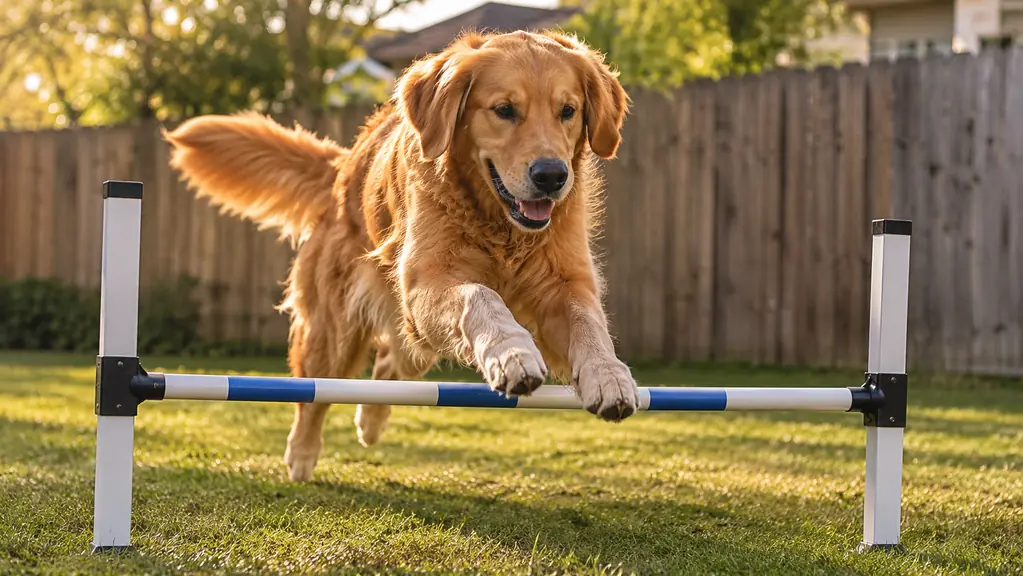
Two things happen the week you decide to train agility at home. You start shopping for equipment, and you start standing in your yard doing math about whether the two will fit together. My yard outside Boise is a small fenced rectangle with a couple of practice jumps already in it. My Border Collie Juno is four years old, forty pounds, and treats every open stretch of grass as a personal invitation. So I bought the JMMPOO Dog Agility Training Equipment kit, and in a fit of confidence the summer before that, I also built a DIY course out of PVC pipe and plywood. Both are still in my garage. Only one of them gets used on a Tuesday night after work.
The short answer comes down to where you are in the sport. The JMMPOO kit wins for anyone starting out, training in a small space, or wanting a course they can set up and put away before the dog cools down. A DIY build wins once you already know what your dog needs and you are ready to own the thing permanently. The kit hands you eight weave poles and a bag. The DIY route hands you exactly the course you designed, plus every hour of work that goes into it.
| JMMPOO Agility Set | DIY Backyard Course | |
|---|---|---|
| Setup and teardown | 8 pounds of parts, a few minutes to lay out, back in the storage bag the same session | Built once and left standing, or rebuilt every time you want to train |
| Storage between sessions | Everything fits in the included storage bag and lives in a closet or a hatchback | Stays in the yard taking weather, or takes up a corner of the garage |
| Weave poles | 8 weave poles included, usable on day one | Cutting, capping and setting eight poles is a project of its own |
| Jump height | Adjustable hurdle out of the box, one dog or several | Adjustable only if you plan the fittings before you cut the pipe |
| Fit to an odd-shaped yard | Standard footprint, wants a clean rectangle of open grass | Cut to whatever shape your fence line actually allows |
| Contact obstacles | None. No A-frame, no teeter, no dog walk | The main reason people build in the first place |
| Durability with a hard-driving dog | 190T tear-resistant polyester tunnel and light floor bars, fine for training, movable by a dog that body-slams | Schedule 40 pipe and plywood absorb real contact |
| Training extras in the box | Pause box, whistle, jump rings and 2 pet tennis balls included | You buy or improvise every one of them |
| Growing into a full course | You add a second set or trade up when the dog earns it | Add one obstacle at a time, sized to your own plan |
What Actually Comes in the JMMPOO Kit
The listing says 60 pieces and 8 pounds, which tells you most of what you need to know about how it is built. This is equipment meant to be carried, not bolted down. Inside the bag you get a collapsible tunnel in 190T tear-resistant polyester, 8 weave poles, an adjustable agility hurdle, jump rings, a square pause box, a whistle, 2 pet tennis balls and the storage bag itself. There are 8 short floor bars at 12 inches with outside caps and 4 long floor bars at 22 inches. Set up, the whole thing runs about 57 by 27 by 36 inches, and the listing rates it for small, medium and large dogs.
What it does not include is anything your dog has to climb. No A-frame, no teeter, no dog walk. That matters more than it sounds, because contact obstacles are where a dog learns to judge height and stride, and they are the expensive pieces to buy ready-made. The kit is a flatwork and speed kit. Jumps, weave poles, a tunnel, and the control pieces that teach a dog to stop in the middle of all that speed.
I laid the whole thing out on the lawn that first Saturday and measured it, because I wanted to know what I was actually giving up. Fully spread, with the tunnel open and the hurdle at a height Juno could clear from a standstill, the course ran just under five feet deep and a little over two feet wide at the widest point. My yard is about thirty feet across at its widest, so a tunnel, a line of eight poles and a hurdle fit with room left to turn around. Not generous room. I moved the pause box twice before I found a spot where I could send her to it without her clipping a pole on the way through.
The jump rings are the piece people ask about most. They are what they sound like, a ring to send the dog through, and they are genuinely useful for teaching a send away from your body, which is a skill that shows up on every course you will ever run. The 2 pet tennis balls are a bonus. The whistle is the piece I use most, mostly for a recall off the far end of the tunnel. None of this is competition-grade gear. It is a starter kit, and it does not pretend otherwise.
What I Liked
- Everything needed for a first season in one bag that weighs 8 pounds
- 8 weave poles included, which is the piece people most underestimate
- Adjustable hurdle covers a young dog and an experienced one with the same frame
- Pause box and whistle give you a way to teach control, not just speed
- Sets up on grass, gravel or a club field and comes back down the same session
Where It Falls Short
- The tunnel and floor bars are light, so a fast dog will move them
- No contact obstacles, so it will not carry you past the beginner level
- Light gear and wind do not get along
- You will outgrow it if you get serious about the sport
Where JMMPOO Wins
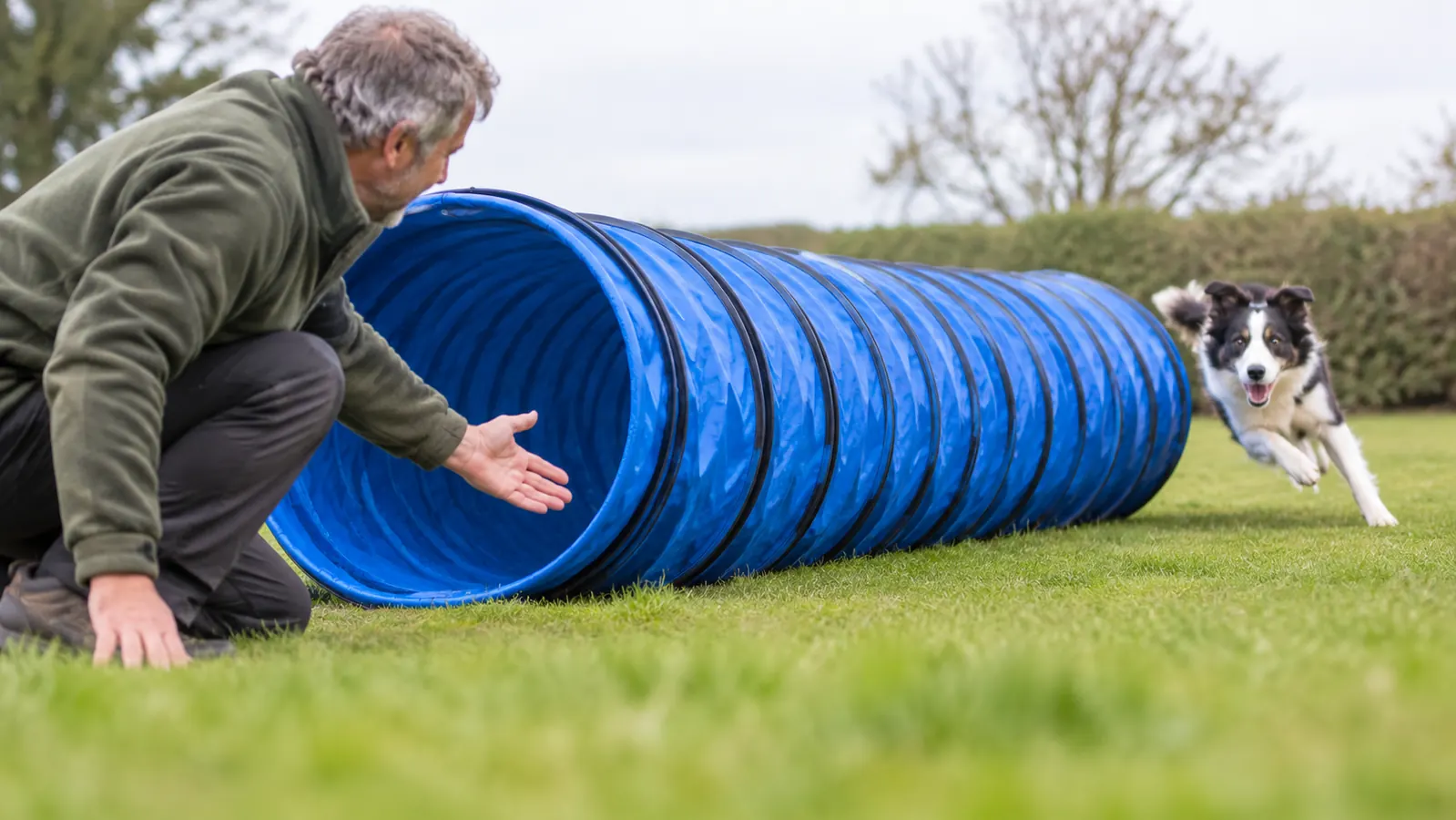
Time. That is the whole argument. From bag to usable course is a few minutes: stand the weave poles up, set the hurdle to Juno's height, open the tunnel, drop the pause box. When you are squeezing training in after work and before the light goes, that matters more than anything on a spec sheet. My DIY course could not be assembled in five minutes because it was never designed to come apart. It lived in the yard, which meant it took the weather, the sprinkler, and the dog.
The second win is that the kit teaches a beginner the right things in the right order. The pause box and the whistle are not filler. A high-drive dog learns speed in about four minutes and learns to hold a position in about four months. Having a physical box to send Juno to, and a whistle that reliably means something, let me build control into the same sessions where she was sprinting. Homemade courses tend to be jumps and a tunnel, because those are the fun things to build. The kit includes the boring pieces, and the boring pieces are where the training actually happens.
The third win is portability, and I did not expect to care about it as much as I do. The bag goes in the hatchback with room to spare. I have set the course up at a friend's field, at the club on a quiet Sunday when the main field was booked, and once on a strip of grass at a family barbecue where Juno was getting unbearable. A permanent course does one location. This one goes where the dog goes.
Where a DIY Course Wins
Durability, plainly. Juno hits equipment at speed. She comes out of a tunnel like something is chasing her, and she has put a shoulder into an upright hard enough to knock a whole jump flat. Schedule 40 pipe with proper fittings absorbs that and asks for more. The kit's tunnel is 190T tear-resistant polyester, which is a reasonable material for a dog that runs through it and a poor one for a dog that brakes inside it. After one season mine carries scuffs and a soft spot. It still works. It will not take five years of this.
The build itself is a weekend you do not get back, and I say that as someone who enjoys a project. I cut twenty lengths of pipe by hand on a Saturday and got the fittings wrong on half of them, so Sunday was a second trip to the hardware store and a second round of cutting. Then primer, then paint, then two days of waiting for it to cure before Juno was allowed anywhere near it. Three weekends in total, counting the sanding on the A-frame surface, and that is before the first rep of actual training.
Second, the obstacles the kit does not have. A low A-frame with a sanded surface and a plank dog walk on blocks cover ground the 60-piece kit never touches, and those two are the reason most people start building in the first place. And there is the geometry problem. If your fence line runs at an angle, or the only flat part of your yard is an L-shape, you cut pipe to fit and the problem disappears. The kit wants a rectangle. Mine has one, barely, and I gave up a flower bed to get it.
Start with the obstacles that fit in a hatchback
The JMMPOO kit covers tunnel, weave poles, adjustable hurdle, jump rings and a pause box in 8 pounds of gear you can set out in a small yard and pack away before the dog cools down. If you have never trained agility and you want to find out whether your dog loves it, this is the sane first purchase.
Amazon Check Today's Price on Amazon →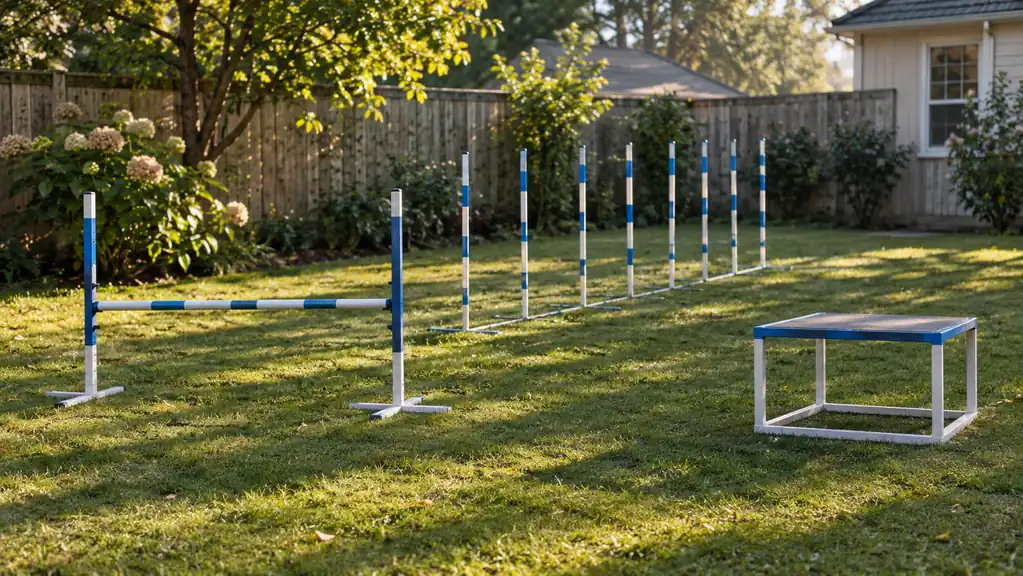
How Both Held Up Over One Season
I ran both through a full spring and summer, three or four short sessions a week, plus a Wednesday night at the club field where the equipment is heavier and better made. That contrast was the useful part. On the club's gear Juno commits to a tunnel without hesitating, because it does not shift under her. At home, on the kit's tunnel, she learned to slow down at the entrance. That is not exactly a flaw in the kit. It is what light equipment teaches a fast dog, and honestly it is a lesson worth learning before you get to a competition tunnel.
What held up best was the hurdle and the weave poles. The adjustable hurdle covers a forty-pound dog comfortably and would still work for something much bigger, and the frame has not bent or lost its settings. I expected to hate the weave poles and I did not. Eight is the right number for teaching entries and rhythm, and having eight of them on day one meant I never had to build a set, which is the single most tedious project in backyard agility. Eight poles, spaced right, teach a dog more about footwork than any jump height ever will.
By July I had folded and unfolded that hurdle somewhere north of sixty times, and the pins still hold their settings without slop. The weave pole bases are the part I watch, because a base that splits leaves a hard edge sitting in the grass, and none of mine have. I check them the way I check Juno's paws after a session: quickly, every time, running a thumb along the caps. The worst I have found is one bent outside cap on a short floor bar, which I straightened with my hands and forgot about until I sat down to write this.
The kit did not make Juno faster. It made the first four weeks of training possible in a yard smaller than a tennis court.
Where the kit annoyed me was wind and enthusiasm. Light gear moves. On a breezy afternoon I was resetting weave poles between reps, and a dog who clips the tunnel at full speed drags it a foot off its line. I stopped fighting it and started training early, when the air is still. That turned out to be better for Juno anyway. Heat is the thing I would flag hardest for anyone in the Boise summer: grass that is pleasant at eight in the morning is too hot at two in the afternoon, and no piece of equipment is worth a burnt pad. Train early, keep the sessions short, and put the dog away before she tells you she is done.
One more thing I would tell a first-timer: the footage you see online is dogs running full courses at speed, and that is not what the first month looks like. My first month was Juno walking through an open tunnel while I crouched at the far end making encouraging noises, then a lot of standing in the shade while I reset poles she had knocked over. There is no version of this where the dog is not the slowest part at the beginning. The equipment only has to survive being boring for a few weeks.
Who Should Buy Which
Buy the JMMPOO set if this is your first season. Buy it if your yard is small, shared, or rented. Buy it if you train at a park or a friend's field and need to move everything in one trip, or if you are still working out whether your dog cares about agility at all. It is also the right call for a one-dog household with a full calendar, because a course that sets up in minutes gets used and a course that takes an hour quietly stops being used around week three. That is the honest failure mode of the DIY route, and it has nothing to do with how well you build.
Build your own if the sport has already stuck, if you have a permanent spot for it, and if you are ready to own contact obstacles, because that is where the training value sits once the basics are in place. My recommendation for most people reading this is to start with the kit, run it for a season, and let your dog tell you whether plywood and pipe are worth your weekends. If she lights up on the weave poles and starts offering the tunnel before you ask, you will know. If she trots through it twice and goes to sniff the fence, you have saved yourself a month of cutting pipe.
Give it a fair twelve weeks before you decide either way. The first two weeks with Juno were mostly her dragging the tunnel sideways and me resetting it, and I would have told you the whole thing was a waste of a Saturday. Somewhere around week five she started driving to the pause box on her own, and that is the moment the equipment stopped being a pile of parts in the grass and started being a course. No kit does that for you. All it can do is be easy enough to set up that you keep showing up long enough for it to happen.
One bag, eight obstacles, and a dog who finally has a job
The JMMPOO 60-piece set gives you a tunnel, 8 weave poles, an adjustable hurdle, jump rings, a pause box and a whistle without a single trip to the hardware store. Set it up tonight, watch what your dog does with it, and build the permanent course later if she earns it.
Amazon Check Today's Price on Amazon →