
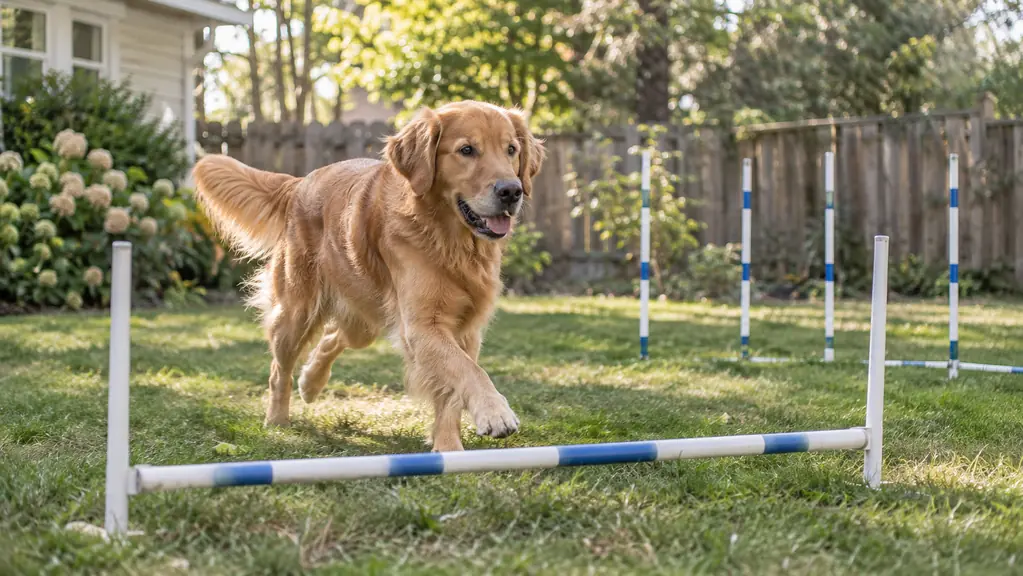
Juno is a 4-year-old Border Collie who will chase a ball until her legs quit, and that is exactly the problem. A tired dog is not the same as a satisfied dog. Tired dogs still pace the kitchen at nine at night, still stare at me while I eat dinner, still ask for one more throw with their whole body. What changed our evenings was not a longer walk. It was a small obstacle course in our fenced backyard outside Boise, and the JMMPOO 60-piece agility starter kit is the one that stayed set up instead of getting folded back into the garage.
I had already tried the obvious fixes. More fetch. A flirt pole until my shoulder ached. A second loop around the neighborhood that just made her fitter and, somehow, more wound up. Physical mileage builds stamina, and stamina is the last thing a high-drive dog needs more of. What she needed was a task with a beginning, a middle and an end, plus something to think about while she did it. That is the whole case for backyard agility, and it is why this list is about the work the gear lets you do, not about the gear.
One bag, sixty pieces, and a dog with somewhere to put the energy
The JMMPOO starter kit covers the tunnel, weave poles, hurdle, jump rings, pause box, whistle and balls. Set it up once and leave it up.
Amazon Check Today's Price on Amazon →A high-drive dog needs a job more than a bigger yard
I have a small backyard. Juno does not care about square footage, she cares whether something is being asked of her. The JMMPOO kit works because it turns open grass into a sequence: run the tunnel, weave, clear the hurdle, hold in the box, release. That sequence is the job. She gets the same physical output in a fraction of the space, and she gets a rule set, which is the part that actually settles her.
The tunnel turns a tight space into a confidence rep
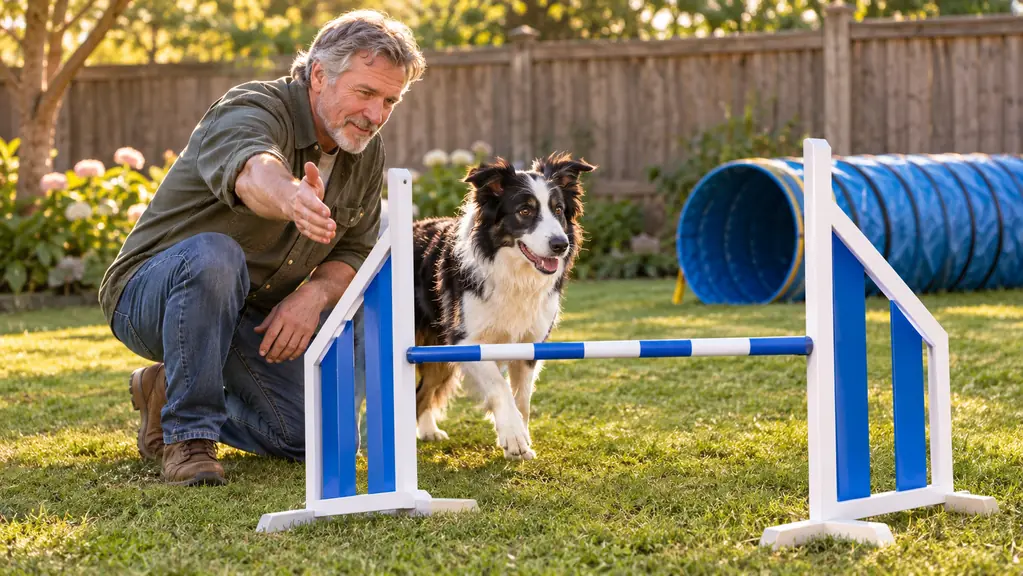
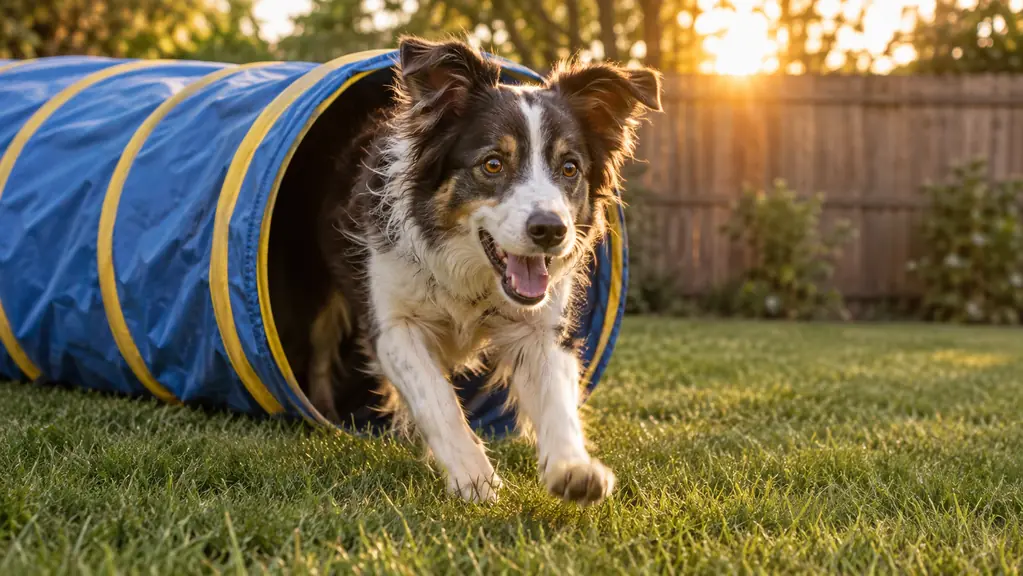
The tunnel in this set is collapsible and made of 190T tear-resistant polyester. Tear-resistant matters more than it sounds. A dog who banks a turn hard inside a tunnel drags her pads along the wall, and thin fabric fails there first. Juno came to tunnels already confident, but I have watched club dogs of every size get brave in three reps once the tunnel is short and the stakes are low. Collapse it, praise, extend it. That progression is worth more than the tunnel itself.
Eight weave poles teach rhythm, and rhythm is mental work
There are eight weave poles in the kit, which is enough to teach the entry and the rhythm without asking an inexperienced dog for a full competition set. Weaving is the most mentally expensive thing on the course. The dog has to bend, time her stride and hold a pattern while moving fast. Fifteen minutes of weave entry work tires Juno more than a mile of flat running, and she sleeps better for it.
The adjustable hurdle lets me meet her joints where they are
The hurdle is adjustable, and that is the point. I keep it low for most sessions. Juno is four and sound, and I still do not jump her high, repeatedly, in a backyard on hard ground. Low repetitions with clean form build the habit. High repetitions build a vet bill. Whatever height you land on, set it once, check it, and stop the session while she is still succeeding.
Jump rings change the shape of the approach
Jump rings are the piece most people skip, and they are the piece that teaches a dog to look for the obstacle instead of running at the grass. The ring reads as a different silhouette from the hurdle, so the dog has to actually look. Juno will offer the ring on her own now when she is unsure what I want, which is a small thing that makes the whole course feel like a conversation instead of a drill.
Eight pounds of gear in one bag, ten good minutes before work, and a collie who now sleeps through the evening instead of pacing it.
The square pause box is where impulse control gets trained
A pause box is a square on the ground, and it is deceptively hard. The dog has to stop, hold, and wait while you move. That is the exercise that carries over to the front door, the vet clinic and the trailhead. Juno's stay got better in two weeks of pause box work than it had in a year of asking her to hold in the kitchen, because here she had already run and jumped and the ask was harder.
The whistle and two balls turn the course into a release game
The kit includes a whistle and two pet tennis balls. I use the balls at the end, not the middle. The course is the work, the retrieve is the pay. Two balls means I am not fishing a slobbery one out from under a bush, and the whistle gives me a recall cue that cuts through wind. Ending every session with a retrieve is why Juno drags me toward the course instead of away from it.
Twelve short floor bars and four long bars let me rebuild the layout
The set comes with eight short floor bars at 12 inches with outside caps and four long floor bars at 22 inches. Those caps are the difference between a bar that lasts and a bar that splinters where it meets the ground. Because the bars are separate pieces, I can change the layout every few days. A new sequence is new work, and new work is what keeps a clever dog from getting bored with her own backyard.
Eight pounds and one storage bag means it actually gets used
The listed package is 57.09 by 27.56 by 36.22 inches and 8 pounds, and it all goes back into the storage bag. That number is the reason this set gets used. Gear that takes twenty minutes to set up and twenty to break down gets used twice and then lives in the garage. I can lay this out, run a session and have it packed before my coffee goes cold. Convenience is a training variable.
Short sessions beat long ones every single week
Ten minutes, twice a day, with a real stop in between, does more for Juno than one long session on Saturday. The shape of it: two or three tunnel reps, a weave entry, three jumps, a pause box hold, then the balls. If she starts knocking bars, we are done. That rule protects her joints and keeps the work sharp. The gear makes the session easy to set up. The stopping is the part I had to learn.
What I'd Skip
Two honest notes before you buy. This is backyard gear, not competition equipment. The pieces are listed as floor mount rather than staked into the lawn, so on wet grass a hard turn can shift a bar. That is fine at home and not fine on a timed course. Tear-resistant polyester is also not chew-proof. If your dog grabs fabric for fun, put the tunnel away between sessions rather than testing it. I have not had a bar fail on the JMMPOO set, but I also do not leave it out in the sun for a month. And I would not start this with a puppy under a year or a dog with a diagnosed joint issue without a vet and a trainer in the conversation first. Gear does not warm a dog up, and it does not replace a second set of eyes.
The yard is already there. Give it a job.
Sixty pieces, one storage bag, and enough layout options to keep a clever dog guessing. Set it up, run ten good minutes, put it away.
Amazon Check Today's Price on Amazon →