
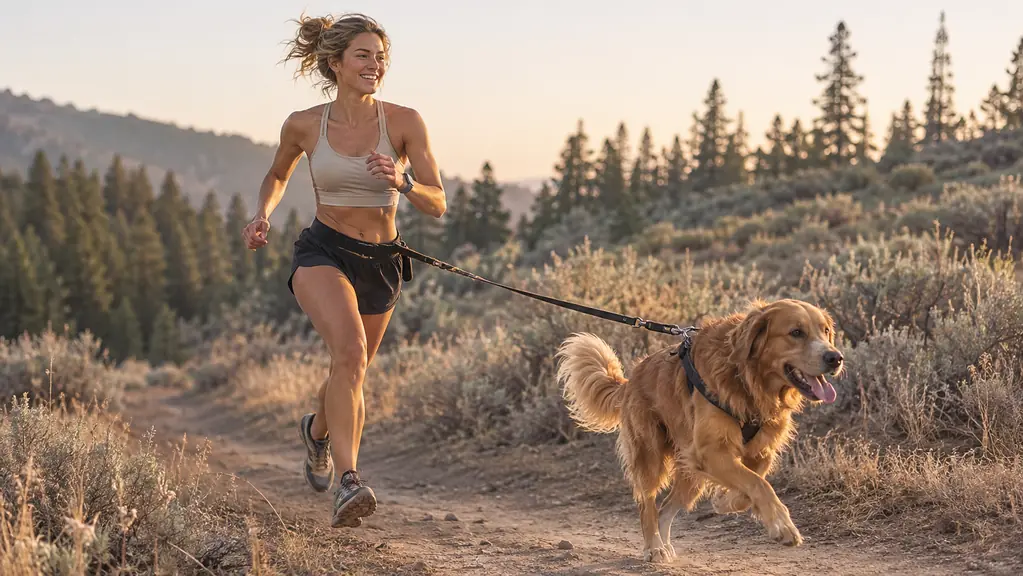
The first time I ran Juno on a waist belt I spent the first mile reaching for the leash with my free hand out of habit. There was nothing there. Juno is a 4-year-old Border Collie, about 40 pounds, and she runs canicross with me on the foothill trails outside Boise. On a handheld leash my right shoulder did all the steering, and by mile three my grip was the weak link in the whole system. The iYoShop Hands Free Dog Leash moved that load to my hips and handed me back two hands. That is the honest headline. But hands free is not automatically better on every run, and there are still mornings I reach for a plain handheld leash instead. I have run both setups on the same routes for six weeks, and the split below is where each one actually earns its place.
Short answer: for running, the iYoShop hands free leash wins. The waist belt moves the pull to your hips and lower back, two shock absorbers take the edge off the surge, and a 2 inch heavy duty clip does the connection. A standard handheld leash wins on three things that matter: it goes on in one second, it fits any handler without measuring, and it hands off to a friend without a conversation. Run three miles or more at a steady pace and the belt earns its place. Do short loops, crowded trailheads and leash swaps between two people, and a handheld is the simpler tool.
| iYoShop Hands Free | Handheld leash | |
|---|---|---|
| Hands during the run | Waist belt carries the leash, both hands free | One hand occupied for the whole run |
| Shock absorption | Two shock absorbers built into the leash | None on a standard flat leash, the jerk travels to your arm |
| Close control in a crowd | Two extra handles plus the waist handle give fixed grab points | You can wrap or choke up anywhere along the webbing |
| Carrying keys, bags, treats | Zipper pouch sits on the belt | Nothing, so it is pockets or a second belt |
| Attaching at the trailhead | Buckle the waist belt, then clip the dog | One clip and you are moving |
| Fits any handler | Waist belt adjusts from 27 to 48 inches | One length fits every human |
| Handing off to another person | They take the belt or the clip, which is one awkward second | Hand over the handle, done |
| Fatigue on a long run | Load sits on hips and lower back | Load sits in one shoulder and one grip |
| Adjusting length mid-run | 68 inch leash on a belt adjustable from 27 to 48 inches | Wrap the surplus around your hand |
Where the iYoShop Hands Free Leash Wins
The load transfer is the whole point. Juno's first thirty seconds on any trail are a launch, not a trot. On a handheld leash that launch arrives in my wrist and shoulder, and over an hour it turns into a low ache that follows me to work the next day. With the belt buckled around my hips the same launch hits a much bigger set of muscles, and my hands stay loose enough to actually run the way I coach other people to run. I noticed it most on the long descent off the ridge, where she surges ahead and I used to brace against her with one arm for a solid half mile.
I keep a note on my phone after most runs, mostly about Juno's gait, and the entry from the second week of October is the clearest evidence I have. That was the four mile climb with the steep descent, about 1,100 feet of gain, and the last half mile drops over loose rock in switchbacks. On the handheld I used to plant my feet and let her tow me down like a ski rope, one arm locked straight out, the other doing nothing useful. On the belt I ran that same descent with my arms swinging. My hands were free to spot my footing, and on loose rock that is the difference between a run and a fall. I came down 40 seconds faster than my handheld best and none of that was fitness. It was not bracing.
The other thing the belt fixed was my right hand. On a handheld it would close up by mile two and stay closed, and I would take it off the handle at every gate just to open and shut it. With the belt the leash runs from the hip to the clip and my hands never touch it unless I want them to. That sounds like a small thing until you do it on a 28 degree morning and realize your fingers are warm for the first time in a winter of running.
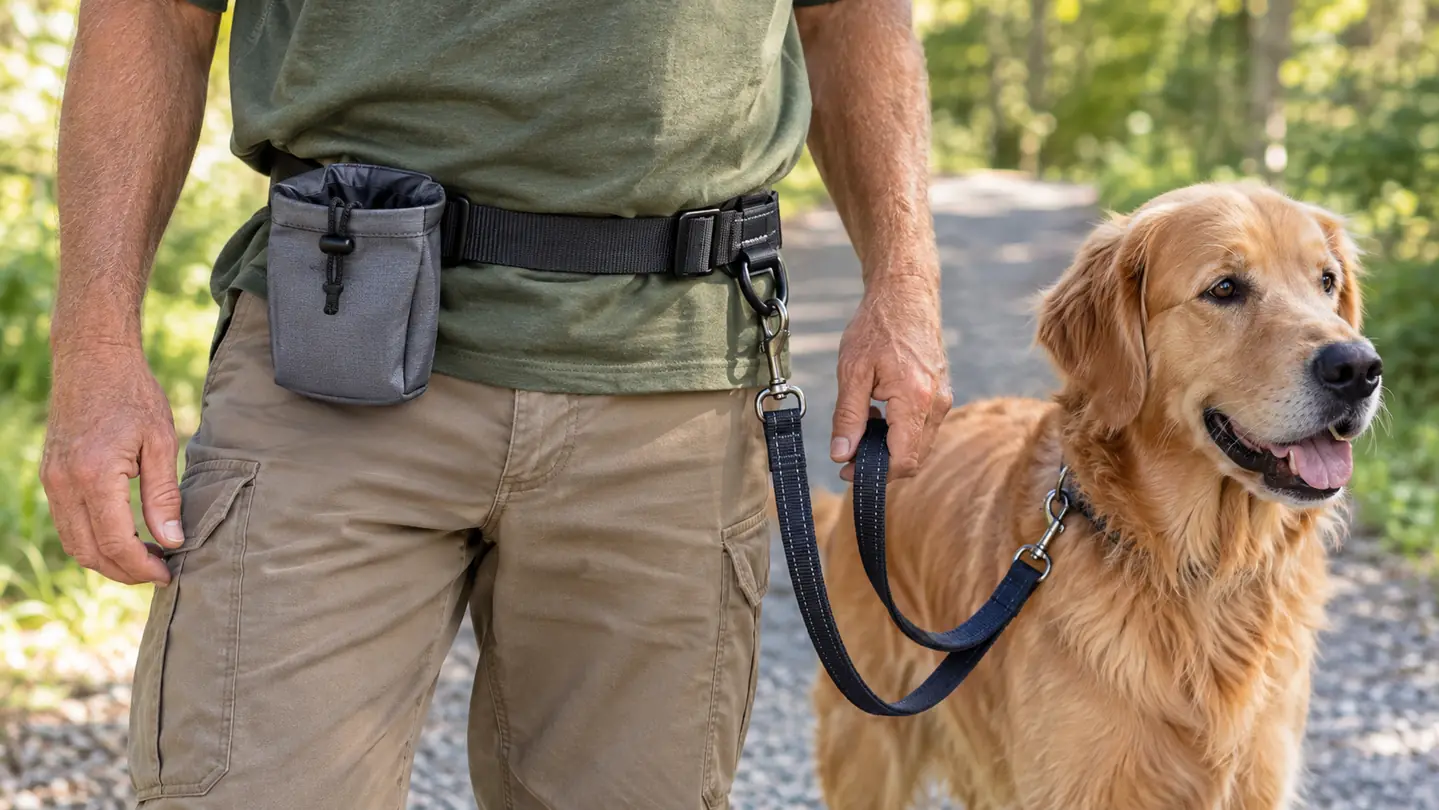
The two shock absorbers do real work, but be honest about what they are. They give the leash a stretch so a sudden stop is not a hard stop. They do not teach a dog not to lunge, and they do not replace a harness that fits properly. What they do is take the snap out of the moment Juno spots a ground squirrel and hits the brakes. She did it twice on the canal path last week and both times I felt a soft pull rather than a jerk. The 2 inch clip is easy to work with cold fingers, and the D-ring next to it is where I hang a clicker for the club field so it is not rattling in my pocket.
Then there is the small stuff that turns out not to be small. The zipper pouch takes a roll of bags, my truck key and two treats, which means I stopped wearing a second belt for a fifteen minute run. I have not tested it in real rain, so my phone still rides in my jacket pocket. The waist belt adjusts from 27 to 48 inches, so it sits on my hips over a summer shirt and still closes over a winter layer. And the 68 inch leash is long enough for Juno to work ahead on a climb without me hauling her back every ten steps.
Where the Handheld Leash Wins
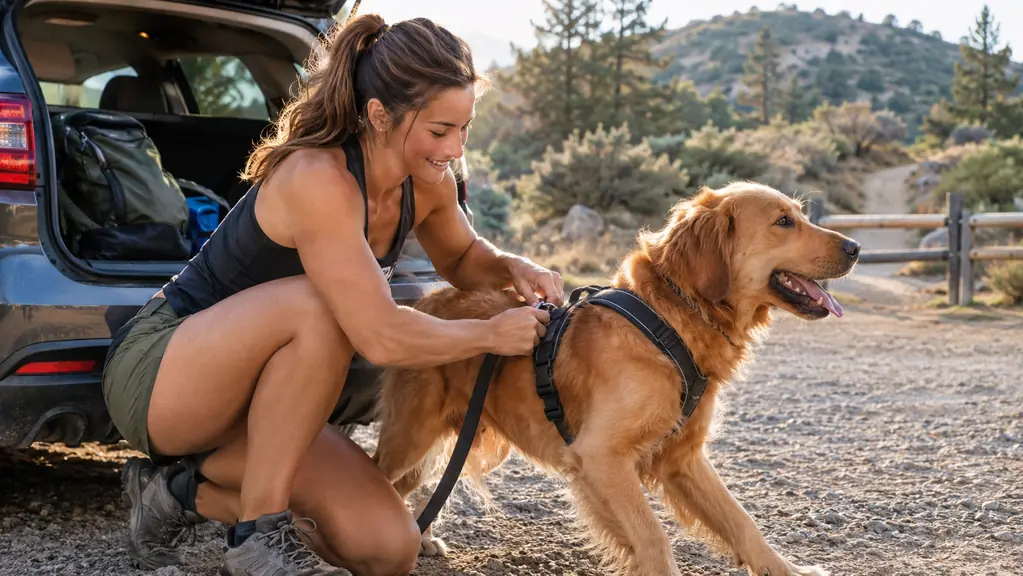
What the handheld gives you is speed at the trailhead, and it is easy to underrate that until you have stood in a gravel lot at 28 degrees with a Border Collie doing circles around your legs. My routine with the belt is open the hatch, put the belt on, set the buckle, check the clip, then clip Juno. With gloves on, the buckle is the part that costs me time. It is a good buckle and it has never slipped. It still takes two hands and sometimes a second attempt when my fingers are thick. The handheld is one clip and we are walking. On the mornings I am running late for the club field, that is the whole decision, and I have left the belt in the car because of it.
It also fits anyone, and it hands off cleanly. The belt covers a waist from 27 to 48 inches, which is generous but not universal, and a handler outside that range is stuck no matter how good the design is. A plain leash fits a tall friend, a teenager, a visiting relative, no adjustment needed. When my husband takes Juno for the cool down lap, a handheld means he takes the handle. With the belt, someone unbuckles or takes the clip, and for a dog who thinks the run is over, that handover is the exact moment she tests the whole system. The first time we tried it she spun at the clip and it caught her shoulder. Nothing broke. It was still two stupid seconds a plain leash would not have created.
The waist belt did not stop Juno from pulling. It stopped her pulling from wrecking my shoulder.
What Six Weeks of Running Both Actually Showed
I ran both setups on the same three routes for six weeks and kept a count of the runs I finished with a sore shoulder. Route one was the canal path: flat, two miles out and two back, gravel, a handful of dog walkers each morning. That is the route where the handheld is honestly fine, because there is nothing to brace against and I am rarely going faster than an easy jog. I still wore the belt most days, but the difference in how my shoulder felt afterwards was a rounding error.
Route two was the climb, the one with the ridge and the loose descent. That is where the two setups separated. On the belt I could hold a steady effort uphill because I was not fighting the leash with one arm. On the handheld I would push for two minutes and then spend a minute managing her. Same dog, same trail, different run. Route three was the club field, where the leash is mostly a legal requirement rather than a steering device. Both work there. The belt is a little better because the pouch holds the clicker and the treats and I am not setting things down on the grass while Juno breaks a stay.
The tally: nine sore shoulders out of fourteen handheld runs, one out of eighteen belt runs, and that one was a morning I left the belt in the car and used the handheld out of laziness. I also counted how often the leash wrapped around my leg. Handheld, eleven times. Belt, twice, both on tight single track where Juno cut behind me. That is the whole case, and it is not a dramatic one. It is a lot of small irritations that stop happening.
Take the Pull Off Your Shoulder and Put It on Your Hips
The iYoShop hands free leash carries two shock absorbers, a 2 inch heavy duty clip, two extra handles for close control and a zipper pouch, all on a waist belt that adjusts from 27 to 48 inches. Today's price and the current sizing are on the listing.
Amazon Check Today's Price on Amazon →Who Should Buy Which
Buy the iYoShop if you run. Not walk, run. Juno and I do three to six miles three days a week plus a canicross start most weekends, and the belt is the reason my shoulders still feel fine on Monday. It also suits anyone whose dog falls in the 25 to 120 pound range in the product title, which is a wide spread for one design, and the 2 inch clip is the part I would want to hold up at the top of that range. The whole thing carries a 1 year warranty, which for gear that lives in a gravel lot is the right kind of boring. If your dog surges, brakes and cuts across your line, the shock absorbers plus the two extra handles give you a way to shorten up fast without wrapping webbing around your hand.
Stay with a handheld if your outings are short, if two people swap the leash constantly, or if you do most of your walking where dogs appear around every corner and you want a hand free to body block. A handheld also makes more sense if your waist falls outside 27 to 48 inches, because no amount of good design fixes a belt that will not close. And if your dog is under 25 pounds, the belt is more gear than the job asks for.
One more note, because I care more about joints than about gear. Whichever you choose, the leash does not set the pace. Juno will run until she drops if I let her, so I cap her hard efforts, warm her up before the climb and check her pads after the descent. In July I move our runs to before seven in the morning and keep them under three miles, and no piece of gear changes that math. A waist belt makes it easier to keep both hands free to manage all of that. It does not do any of it for you, and no leash on the market changes that.
One Piece of Gear, Both Hands Free
If your runs are longer than your driveway, the iYoShop hands free leash is the version that leaves your shoulders out of it. Check the waist range against your own measurements before you order, and see the full size chart with today's price on the listing.
Amazon See the iYoShop Hands Free Leash on Amazon →