
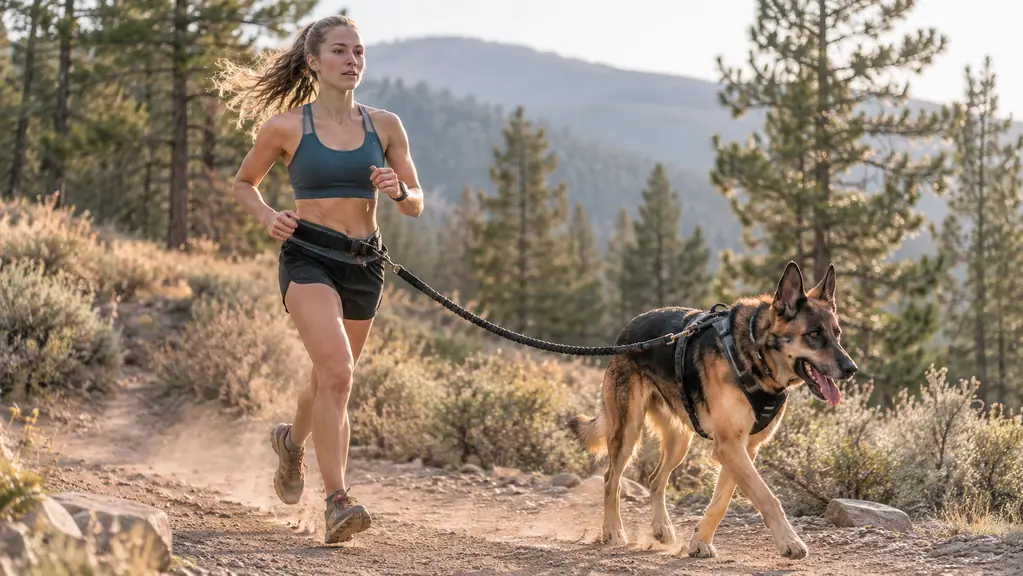
Here is the part of this review that most people skip. I did not want a hands free leash so I could text on walks. I wanted one because Juno, my 4-year-old Border Collie, is roughly 40 pounds of forward momentum, and we run canicross together on the foothill trails outside Boise. On a handheld leash, my right shoulder was doing work it should not have been doing, and my day job as a physical therapy assistant means I notice that quickly. The iYoShop hands free leash with the zipper pouch has been in my training bag for about eight months. It has seen roughly 200 miles of trail, a lot of agility club warmup loops, one muddy spring, and a morning where Juno found a rabbit and I found out what the belt does under load.
So this is not a first impression dressed up as a review. The novelty is long gone, the pouch zipper has grit in it, and the elastic has been yanked by a dog who sincerely believes she is racing. Some of what iYoShop lists holds up exactly as written. Some of it holds up only if you set the belt up correctly, and that setup step is barely mentioned anywhere. And there is one thing about hands free leashes in general, this one included, that I wish someone had told me before my first season.
The Quick Verdict
A sturdy, genuinely useful waist leash for a dog that already pulls in a straight line. The double shock absorbers soften the first half second of a lunge and the belt moves that force from your shoulder to your hips. It will not train your dog for you.
Amazon Check Today's Price →The waist leash I still pack after eight months and 200 miles
Double shock absorbers, a 2 inch clip, a waist belt that adjusts from 27 to 48 inches, and a zipper pouch for bags and treats. Shown here in the size and weight range iYoShop lists.
Amazon Check Today's Price on Amazon →How I've Actually Used It
My setup is boring on purpose. The waist belt adjusts from 27 inches to 48 inches, and I wear it around 32 inches over leggings and closer to 36 when it goes over a rain shell in February. Juno runs in a padded harness, never a collar, and the leash clips to the back of that harness with the 2 inch clip. The first mile is always the honest test, because that is when she is freshest and most willing to test the end of the line. On a flat gravel path she settles into a steady pull and the belt sits still. On a downhill with a scent in the air, the belt moves.
Most of our mileage is canicross pace on wide dirt trails, plus short technical sections where I want her close. That is where the second handle earns its place. It sits back near the clip, so I can bring her in to about an arm's length without unclipping anything or wrapping the leash around my hand. For agility club warmups, when she is bouncing and I am trying to keep her from saying hello to every other dog on the field, that handle gets used more than the belt does.
The zipper pouch is the part I expected to ignore and did not. It holds a roll of bags, a handful of treats and my key, and the zipper has stayed shut through eight months of trail dust. It is not big enough for a water bottle or a phone in a thick case, so I still carry a small belt pack on longer runs. But for a 45 minute loop it means I leave the house with one thing instead of three.
Wear check at eight months. The elastic has not gone slack, the stitching at the clip has held, the belt buckle still clicks with a positive feel, and the only visible damage is dust in the webbing and a scuffed clip. The part I watch is the elastic, because elastic is always what dies first on a bungee leash. So far it has kept its shape and its spring. If that changes I will say so.
What the Specs Actually Tell You
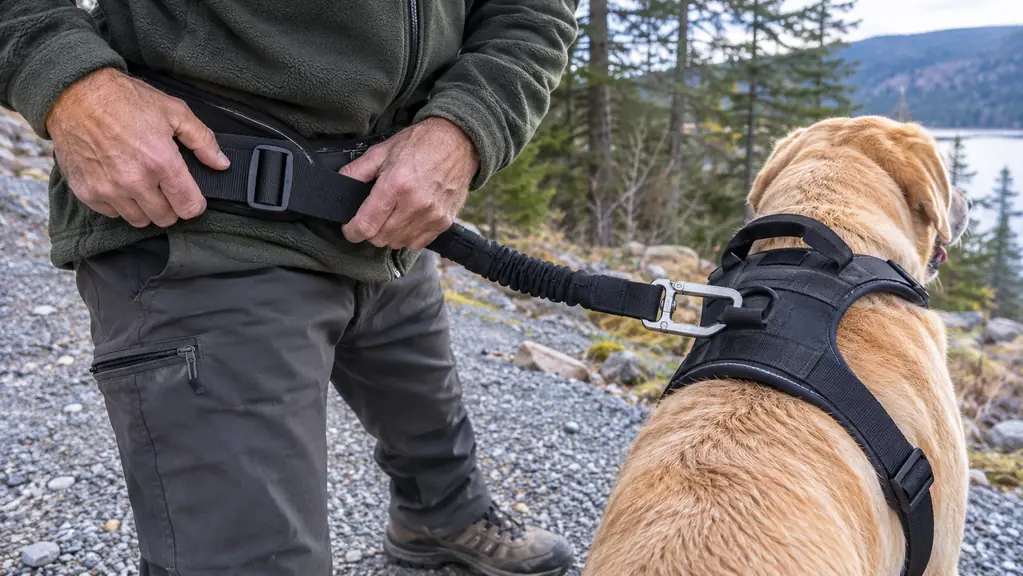
The leash measures 68 inches from end to end and is 1 inch wide. That length matters more than any other number here. 68 inches lets Juno run out ahead of me on a descent without me shortening anything, which is exactly what you want at canicross pace. It is also far too much leash for a sidewalk beside a road, a trailhead parking lot, or any place where a reactive dog might appear around a corner. You handle that with the close control handle, not by hoping.
The whole leash weighs 9.6 ounces. It is light enough that I forget it is on the belt until Juno hits the end of it. The closure is a buckle, the clip is a 2 inch heavy duty clip, and there is a D ring on it for a clicker or a tag. I have small hands and I can work the clip with thin gloves on. With thick winter gloves it takes a second try, which is worth knowing if you run in a cold climate.
Setup matters more than the listing suggests. The belt wants to sit low, across the hip bones rather than up at the waist, and the leash wants to clip to the back of the harness rather than the front. A front clip harness plus a waist leash pulls the dog's shoulders sideways and felt genuinely bad the one time I tried it. Back clip, low belt, elastic loaded in a straight line. Do that and the whole thing behaves.
The waist belt range, 27 to 48 inches, covers a lot of bodies and a lot of layering. And iYoShop backs the leash with a 1 year warranty. The listed dog size is Large, and the title gives a 25 to 120 lb range. That range is wide. Keep it in mind, because it is the source of my main complaint further down.
The Shock Absorbers, Honestly
The leash has two shock absorbers built into the line. They are elastic sections that extend when Juno loads them and contract when she eases off. Here is what they actually do. They take the sharp edge off the first half second of a lunge. When she spots a squirrel and hits the end of the line, the spike is softer than it would be on a static leash. That is real, and my shoulder can tell the difference over a long run.
Here is what they do not do. They do not make a 40 pound dog weigh less. Once the elastic is fully stretched, you are still attached to a dog who wants to go somewhere you do not, and the belt is still sending that force into your hips. Anyone who tells you a bungee leash removes the pull has not run behind a high drive dog. It softens the impact. It does not delete the physics.
Where it shines is on the descent. Juno runs downhill faster than I do, and on a static leash that means a series of hard little jerks all the way to the bottom. With the elastic in the line, those jerks turn into a steady tension. On a steep mile of switchbacks that is the difference between finishing the run fresh and finishing it with a grumpy shoulder.
There is a safety point that comes with elastic. A bungee leash and a flat collar is a poor combination, because the recoil loads the dog's neck on the way back. Clip to a harness. That is a general rule for running with any dog, and it matters more once there is give in the line. I also would not hand an elastic leash to a dog who is still learning not to bolt, because the give rewards a dog that already pulls by letting it load up and bounce.
The elastic softens the first half second of a lunge. It does not make a 40 pound dog weigh less, and no leash will.
The Two Extra Handles and the Traffic Problem
There are two handles beyond the belt itself. The first is the built in waist handle, which is where the belt attaches and what you would grab if you needed to take the leash off your waist in a hurry. The second sits back near the clip, and it is the one that turns this from an open ground running leash into something you can use in a crowd.
I use that second handle constantly. At the trailhead, in the parking lot, passing a horse, and any time we are on narrow single track where I need her within arm's length. It is the difference between a hands free leash that only works on open ground and one that handles the first and last five minutes of a run, which is where most incidents actually happen.
What it is not is a replacement for leash manners. Hands free does not mean hands off. On a dog who crosses behind you, cuts left into your knee, or stops dead to sniff, the belt turns your body into a pivot point and you will feel it. Juno had two years of leash work before I trusted her on a waist leash at speed. If your dog is still learning, this is the wrong tool for that stage.
What Nobody Tells You About Hands Free Leashes
First, the belt rides up. The belt on this leash is a strap, not a padded hip belt, and under a hard pull it climbs from my hips toward my ribs unless I have it snug over clothing with some grip. Over smooth leggings on a hot day that is a fight. Over a rain shell it stays put. If you are built with narrower hips, budget a couple of runs of adjusting before you find the right tension.
Second, the force moves rather than disappears. A handheld leash loads your shoulder and forearm. A waist leash loads your hips, low back and, if you are not braced, your knees. For me that is a clear improvement, because the shoulder was the part complaining. But if you have a history of low back trouble, a strong pulling dog on a waist belt is not automatically the gentler option, and I would talk to a physio before committing to canicross mileage.
Third, the 25 to 120 lb range has a cost. The hardware has to be safe for a 120 lb dog, so on Juno at 40 lb the clip and buckle feel oversized in the hand. That is not a defect, and I would rather have it this way than the reverse, but if you are buying for a 30 lb dog, know that you are carrying hardware built for a much larger animal.
Fourth, and this is the one I would most want a buyer to hear. A hands free leash does not train your dog. It is a piece of equipment that manages a dog who already has some manners. It will not fix pulling, it will not fix lunging, and it will not fix a dog who zigzags. What it does is free both hands for treats, bags, gate latches and a water bottle on the far side of the trail. That is worth having. It is just not the same thing as training.
What I Liked
- Double shock absorbers take the edge off the first half second of a lunge and make descents much smoother
- Waist belt adjusts from 27 to 48 inches, so it fits over a t-shirt or a winter shell
- 2 inch clip is easy to work with thin gloves on
- Two handles give you a close control option without unclipping anything
- Zipper pouch swallows a roll of bags and a handful of treats
- 1 year warranty
Where It Falls Short
- The belt is a strap, not a padded hip belt, and it rides up under a hard pull
- The 25 to 120 lb range means hardware sized for a much bigger dog
- Elastic rewards a dog that already pulls by letting it load up
- No length adjustment beyond grabbing one of the two handles
- Pouch is too small for a water bottle or a bulky phone case
Who This Is For
This leash suits a runner or hiker with a dog in the 30 to 90 lb range who already walks on a loose-ish leash and pulls in roughly a straight line. It suits canicross and trail runners who want their hands free for a quick treat reward, a gate latch, or a jacket tied around the waist. It suits anyone whose shoulder or elbow has started complaining about handheld leashes and who wants that load moved lower. The 68 inch length, the 2 inch clip and the two handles are the three things that make it work for that job, and iYoShop got all three right.
Who Should Skip It
Skip it if your dog is under the 25 lb floor in the listed range, because the hardware is sized for much bigger animals. Skip it if your dog does not yet have basic leash manners, because the elastic and the waist attachment will make an existing pulling problem feel more dramatic, not less. Skip it if you have low back issues and a hard puller, or if you want a training leash with precise length control, because a waist leash gives you two handle positions and not much else. And skip it if most of your walking is on sidewalks beside traffic, where 68 inches is simply too much leash.
Eight months, 200 miles, one dusty zipper, still in the bag
If you want the load off your shoulder and both hands free for treats and gates, this is the waist leash I keep going back to. Double shock absorbers, a 2 inch clip, a waist belt from 27 to 48 inches, and a zipper pouch that swallows a roll of bags and a handful of treats.
Amazon Check Today's Price on Amazon →