
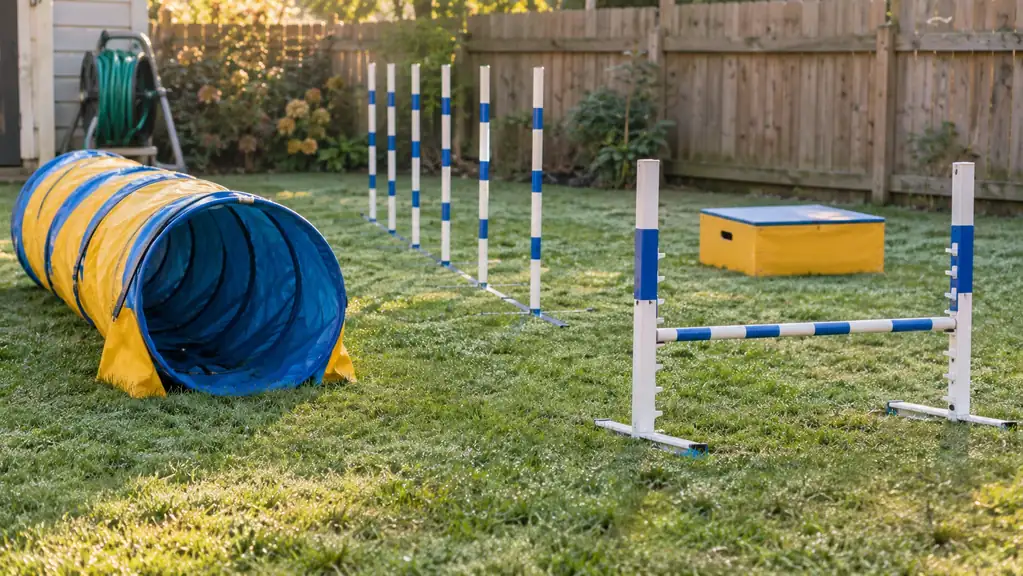
Juno is four years old, about forty pounds, and firmly of the opinion that any flat piece of ground is a race she is already winning. For two summers I built her obstacles out of whatever was in the garage: a broom handle across two buckets, a card table with a blanket thrown over it, a row of tomato stakes borrowed from the garden. She loved every minute of it. The trouble was that nothing stayed where I put it. The handle rolled. The blanket sagged. The stakes leaned a little further each week until the whole arrangement was less a course and more a hazard I had built with my own hands.
A starter kit fixes that, and that is really all it fixes. JMMPOO makes a 60-piece set that puts the same obstacles in one bag: a collapsible tunnel, 8 weave poles, an adjustable agility hurdle, jump rings, a square pause box, a whistle, 2 pet tennis balls, and a storage bag. The listing gives the whole thing as 8 pounds. None of it will train your dog for you, and none of it is built to the standard of the equipment at a competition field. What it gives you is a setup that looks the same on Tuesday as it did on Monday, and repetition is what a dog actually learns from.
The bag that ends the bucket-and-broom-handle era
Sixty pieces, 8 pounds, one storage bag. Juno learned her tunnel and her poles on this set before we ever touched the club equipment.
Amazon Check Today's Price on Amazon →Before You Set Anything Out
The set is listed at 57.09 by 27.56 by 36.22 inches and 8 pounds, which tells you a lot about storage and very little about footprint. How much yard the course takes depends on how far apart you space things, and you control that. I lay mine out on a stretch of lawn roughly 30 feet long and 15 feet wide, which is generous for one dog working one obstacle at a time. A smaller yard still works if you run the obstacles in a tight loop rather than a long line.
Pick ground that is level and short. Long grass hides the base of a weave pole and turns a missed entry into a stumble. Bare dirt is worse once it rains, and a concrete patio or a wooden deck is the wrong surface for a dog turning at speed, since neither gives a paw anything to grip. Walk the area first with your eyes down. Fill any hole deep enough to catch a toe, move the hose reel, and check the fence line for gaps before you add a dog running flat out to the equation. On a hot afternoon, press the back of your hand to the grass. If it is too warm to hold there for five seconds, it is too warm for paws.
Step 1: Lay the obstacles out in one line and walk it yourself
Resist the urge to build a course. Build a path. Set the tunnel, the weave poles, the hurdle, the jump rings and the pause box in a single line down the middle of your space with a comfortable gap between each one, then walk that line yourself, in order, without the dog. You are checking three things: that you can move from one obstacle to the next without stepping over anything, that the ground under each one is flat, and that you have somewhere to stand where you are not in the dog's path.
A line also teaches the dog something a loop does not. A loop lets a dog self-reward by circling back to the tunnel whenever she feels like it. A line makes you part of the sequence, because you are the one moving her from obstacle to obstacle. If your yard is too short for a straight run, a shallow U works better than a circle, since the dog is still travelling away from you and back rather than orbiting.
Keep the gaps wide for the first week. Distance between obstacles is free, and a dog who is not being squeezed between two pieces of equipment stays relaxed. I started with the tunnel a good fifteen feet from the first weave pole, mostly because Juno's tunnel exit is a full celebration and I did not want her landing in the poles.
Step 2: Set the tunnel first and give it a reason to be fun
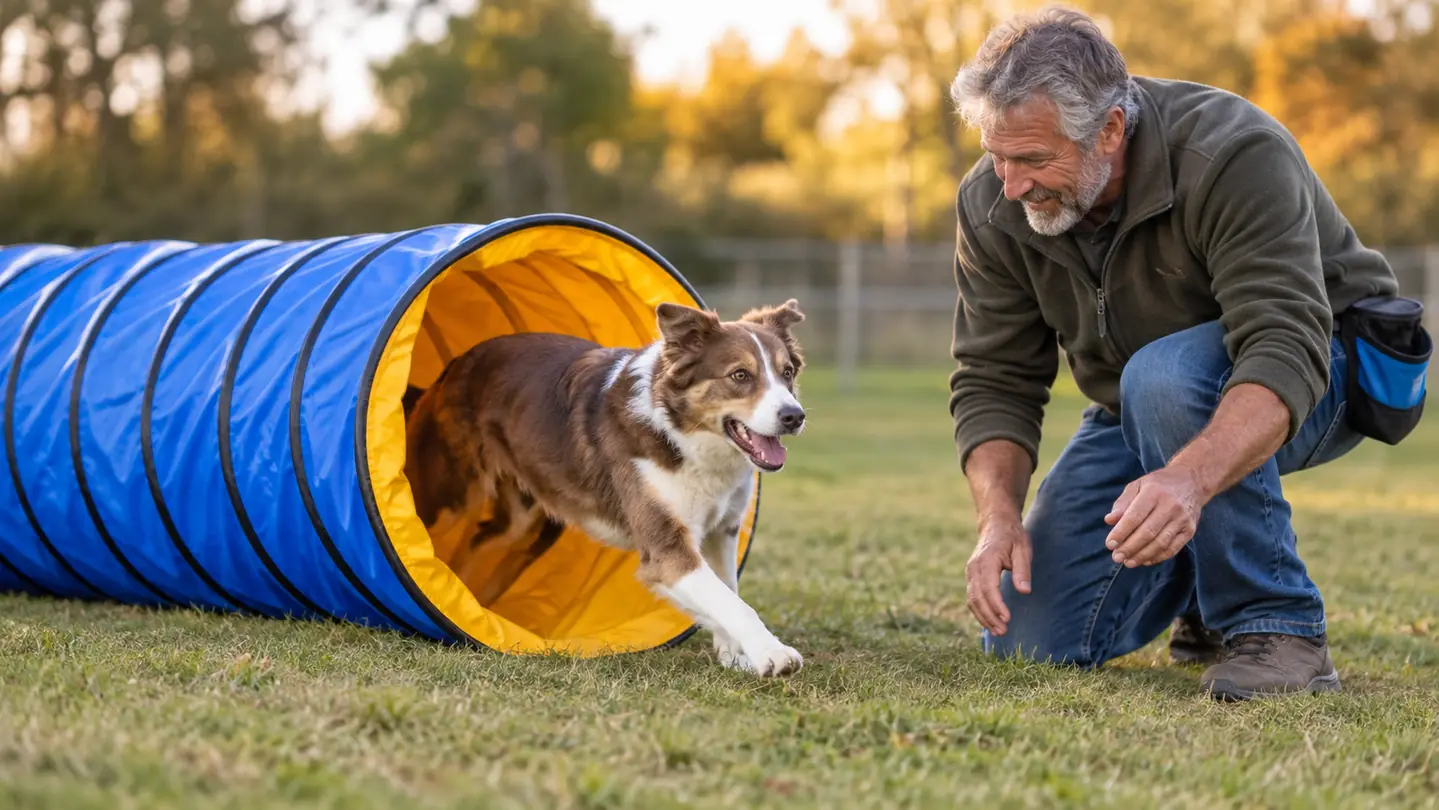
The tunnel is the piece that decides whether the rest of the session goes well. JMMPOO builds this one from 190T tear-resistant polyester, and it collapses down for storage. That fabric is why the tunnel is a good first obstacle for a dog who has never seen one: it has give, so a dog who runs into the side bounces off rather than gets hurt, and a paw scrape does not turn into a hole.
Open it out fully and set it straight before you ask for anything. A curved tunnel looks better in photos and is harder for a beginner dog, because she cannot see daylight at the other end. Once she is driving through a straight tunnel without hesitating, bend it a little and let her solve that. I put Juno's dinner bowl at the far end for the first three sessions, which is not a training method so much as bribery, and it worked.
Wind is the one thing that will ruin a light tunnel. If your yard catches a breeze, set the tunnel across the wind rather than into it and weight the lower edge with something heavy and soft, a couple of sandbags or a folded tarp. Do not stake through the fabric. And do not leave it out overnight when rain is coming, since a wet tunnel is heavier than it looks and slow to dry.
Step 3: Space and plant the eight weave poles
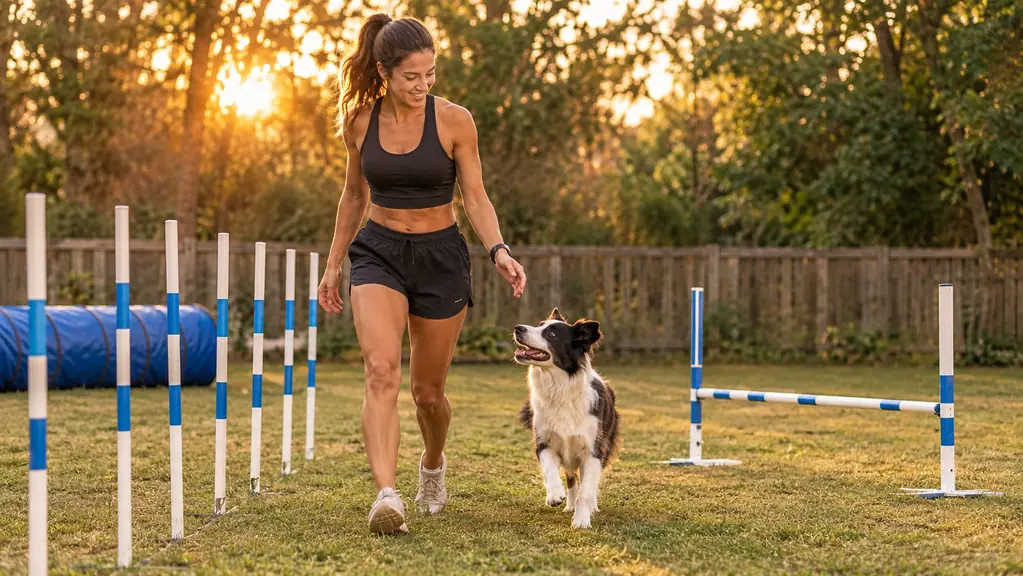
Eight poles is a good number for a backyard. It is enough for a dog to find a rhythm and short enough that you can reset a bad entry without a long walk back to the start. The set does not specify spacing, so you set it. I space mine about 20 inches apart, which is roughly what the club field uses for a dog Juno's size, and I run a tape measure down the row exactly once. After the bases have sat in the ground a week, the grass tells me where they go.
Plant them in a straight line and check the line by standing at one end and sighting down it. A single pole out of line will pull a dog out of the rhythm she just found, and she will not tell you which pole it was. Push each base down until it sits flush. If your lawn is soft, twist the base as you push. If it is hard, water the row the night before rather than forcing it, because a base that goes in crooked will be leaning by the weekend.
The first sessions are about the entry, not the whole row. Send her into the first gap with your hand low and your voice quiet, and stop after three or four poles while she is still succeeding. A dog who is allowed to blow through eight poles badly learns that the poles are something to survive. A dog who is stopped early learns that the poles are something she is getting right.
Eight poles, one tunnel and a low hurdle, always in the same order, taught Juno more in six weeks than a whole summer of bucket-and-broom-handle improvisation.
Step 4: Set the hurdle and jump rings to your dog, not to the photo
The hurdle is adjustable, and that is the only height guidance the set gives you, which means the number is yours to pick. Start with the bar low enough that your dog can trot over it without changing stride. A dog who has to gather herself and leap is a dog jumping too high for her level, and that is how you end up with a dog who is cautious about jumps in a way that is hard to undo.
Measure at the shoulder, not at the ears. Juno stands about 22 inches at the shoulder, and I keep the bar well under that while we are working on speed and handling. Height can come later, and it should come slowly. The jump rings work the same way: set them low, send her through the middle, and reward the moment she commits rather than the moment she lands.
Check both pieces after every session. An adjustable hurdle earns its name by moving, and anything that moves can work itself loose. Push the bar back into its setting, stand the uprights square again, and look at the ground where the feet sit, since a hurdle walked into a divot will sit lower on one side. This takes thirty seconds and it is the difference between a piece of equipment and a piece of equipment that fails mid-run.
Step 5: Add the pause box and the whistle, then run the whole course
The square pause box is the piece most people leave in the bag, and it is the one that pays off fastest. It gives the dog a place to stop, which is the entire foundation of control at speed. Put it at the end of the line at first. Send her in, ask for a down or a stand, feed her in position, then release. Two minutes of that at the end of every session will do more for her course runs than another lap of the tunnel.
The whistle is for you, not for her, at least at the start. Pick one cue and one meaning, keep it short, and use it the same way every time. I use mine to call Juno off the tunnel exit so she does not blast straight into the poles. Blow it before she commits, not after, because a whistle that arrives late is just noise.
Now put it together. Send her down the line in order, keep your own path clean, and stop while she still wants more. Two or three full runs is plenty for a dog in summer, and one is plenty when it is hot. The JMMPOO set gives you a repeatable sequence every time you unzip the bag, which means the training load sits on your handling rather than on your setup, and that is exactly where it should be.
What Else Helps
Treats small enough to swallow at a run, a pouch on your hip so your hand is not diving into a pocket mid-sequence, and a mat or a target for the pause box while she is learning it. A second person helps more than any piece of gear for the first two weeks, mostly to hold a leash or nudge a pole back into line without stopping the session. The two tennis balls in the kit make a decent reward for a dog who values a ball over food.
Film a run on your phone every week or so. You will see things you cannot feel, like a shoulder that drops on the turns or a stride that shortens over the last three poles. Then check the dog, not the course. Paws after every session, especially on dry grass, and a cool-down walk on a leash before she goes back inside. Juno will keep working until she drops if I let her, and the JMMPOO set will happily keep offering her something to do. The pacing has to come from you.
The whole set goes back into the storage bag at the end of a session, which matters more than it sounds. Equipment that stays out gets walked on, mowed over and rained on, and a bag you can carry in one hand at 8 pounds is a bag you will actually use. I leave the poles and the pause box set up through the week and pack the tunnel and the rings, and that split works for us.
Start with a setup that repeats
Sixty pieces, 8 pounds, one bag, and obstacles that sit in the same place every evening. That consistency is the part your dog learns from.
Amazon Check Today's Price on Amazon →