
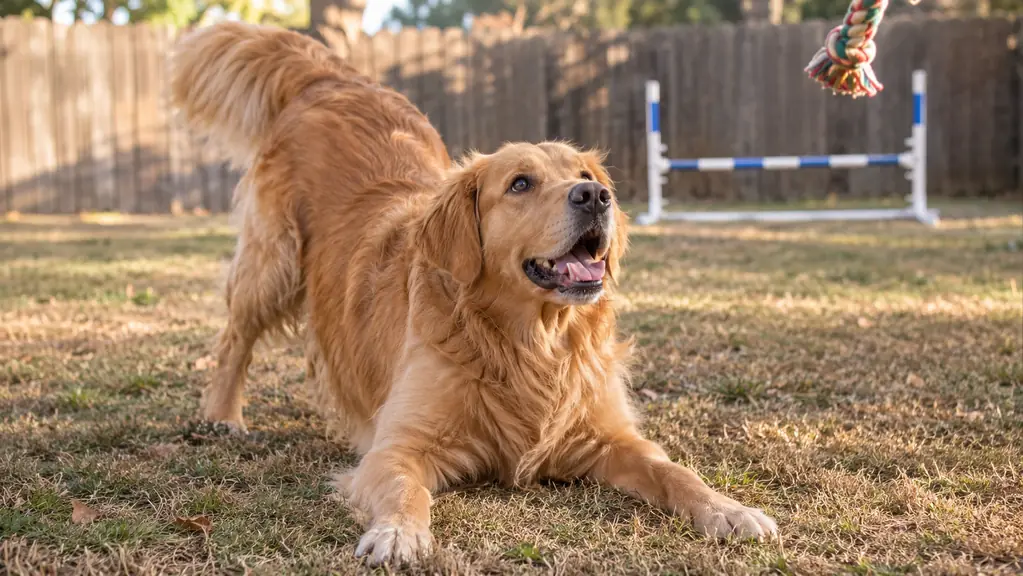
The first thing I noticed about the Squishy Face Studio Flirt Pole V2 was not the pole. It was Juno's face. She is a four-year-old Border Collie, about forty pounds, and she will fetch until her pads wear through if I let her. The moment the lure started swinging, her whole body dropped into that low, coiled stalk I usually only see at the agility club field. So the product works. That was never in question. What I wanted to know, and what this review is actually about, is whether it survives a dog with that much drive for more than a season, and whether using it teaches her habits I will have to untrain later.
I have had this pole in the back of the hatchback since early spring. It has been on the lawn, on the gravel at the foothill trailhead, and on the club field between runs. I have replaced the lure once. I have opinions about what the listing oversells and what it quietly undersells. Below is the version I would give a friend who texted me asking whether it was worth the shelf space, including the parts that annoyed me.
The Quick Verdict
A genuinely useful 36-inch flirt pole that gives a high-drive dog a real workout in under ten minutes. The lure is a wear item and the sizing fields contradict each other. Buy it for the pole and expect to replace the lure.
Amazon Check Today's Price →Juno committed in four seconds. See today's price.
The Squishy Face Studio Flirt Pole V2 ships as one pole and one lure, which is everything you need to start. The 36-inch regular is the size most owners of a forty-pound dog end up with, and it is the one I would buy again.
Amazon Check Today's Price on Amazon →What the Listing Says, and What It Leaves Out
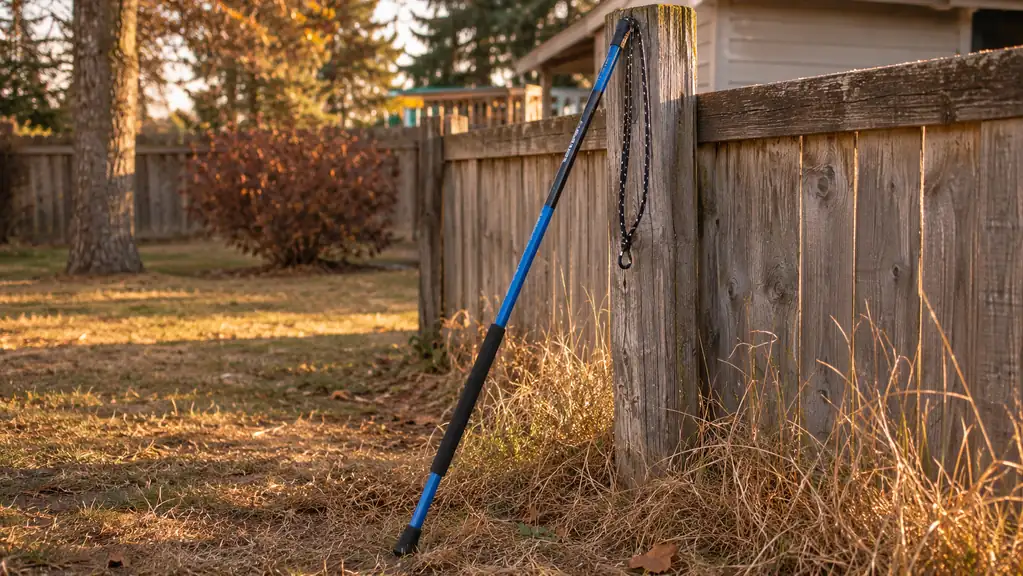
The listing is accurate as far as it goes. The pole measures 36 inches long, roughly 1.5 inches by 1 inch at its widest, and it weighs 12.8 ounces. The lure is polyester and the whole thing is built in the USA. The grip is described as soft and non-slip. That matches what my hand found after a full season of use.
What the listing does not do is explain two things clearly, and both matter if your dog is bigger than a terrier. First, the breed fields pull in two directions. One says all breed sizes and another says small. That is not a contradiction exactly, but it is confusing, and it is why a friend with a sixty-pound shepherd hesitated for a week. Second, the water resistance field says not water resistant, which is honest but easy to skim past. A wet lure on wet grass picks up grit, and grit is what kills stitching. I would rather know that before the first session than after.
How I've Used It
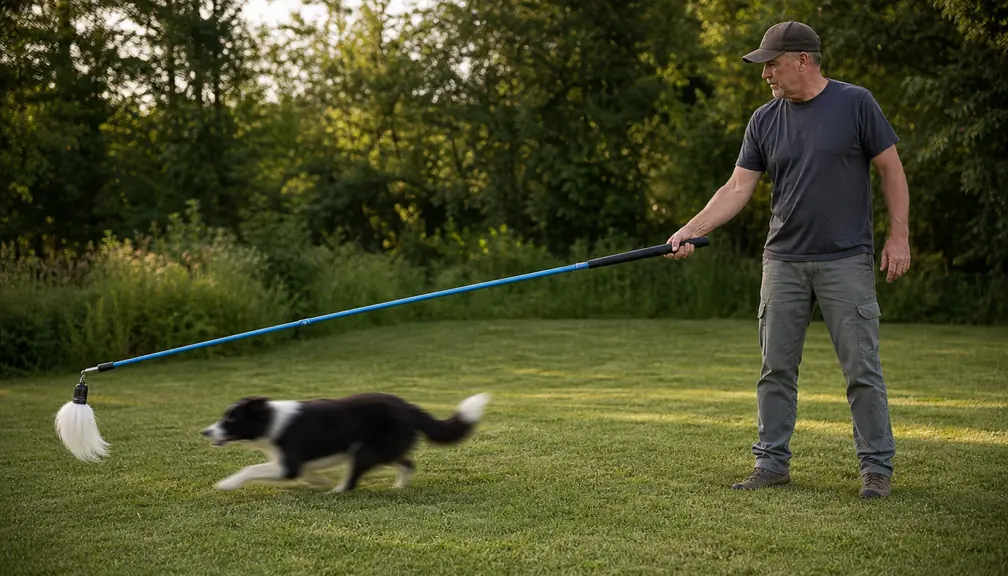
Juno gets two or three sessions a week, ten minutes each, more often in winter when the trails are too icy for canicross. I use it in the small fenced backyard, mostly on grass, and at the club field as a warm-up before we run a sequence. Ten minutes is not an exaggeration in my experience. Her tongue is out and her focus is gone in eight or nine, which is exactly the point of a flirt pole and exactly the reason it is easy to overdo.
The routine is simple. I hold the pole at hip height, keep the lure moving in a low arc, and let her chase. When she catches it she gets a few seconds to hold and shake, then I ask for a drop and we go again. That drop is the whole reason I like this tool. A dog that learns to release the lure on cue is a dog that will release a ball on cue, and that transfers straight to the field.
Her tongue is out and her focus is gone in eight or nine minutes. That is the point of a flirt pole, and it is also the trap.
The Pole: 36 Inches and 12.8 Ounces
Thirty-six inches is the regular size, and for a forty-pound dog it is the right compromise. A shorter pole makes the lure too easy to catch and turns the game into tug. A longer one gives more reach but more flex at the tip, and flex is where a flimsy pole dies. This one is stiff enough through the middle that I can snap the lure sideways without the shaft lagging behind my hand.
At 12.8 ounces it is light enough that my forearm is not complaining after a session, and heavy enough that the tip does not wander in a light breeze. I handed it to a friend with a shoulder injury and she worked it one-handed for a full ten minutes. That is a better test than any spec sheet.
The Lure
The lure is a polyester braid on a cord, and it is the part that wears out first. Mine went fuzzy at the edges within a month and started shedding fibers by the third. That is not a defect, it is what a soft lure does when a Border Collie grabs and shakes it. The good news is that the pole outlives it comfortably, and swapping the lure is a two-minute job.
Where the lure does well is weight. It is light enough that it whips and darts instead of swinging like a pendulum, and light enough that when Juno catches it mid-air it does not jerk her neck. That last point matters more than anything else in this review. A heavier lure would be more satisfying to grab and worse for a dog's cervical spine.
Durability: What Held and What Didn't
The pole has held. No splintering, no separation at the grip, no fraying where the cord attaches. I have stepped on it once, jammed it into the hatchback at a bad angle twice, and left it in the sun more often than I should have. It is not water resistant, so I do not leave it out overnight, and I wipe it down after wet grass. That is five seconds of maintenance and it is the difference between one season and three.
The cord is the honest weak point. It has held so far, but it is the thinnest component and the one taking the most repeated shock load. I check it before every session now, the same way I check Juno's harness stitching. If it ever looks frayed at the knot I will cut and retie rather than risk a snap mid-swing with a dog at full speed.
The Grip
The grip is soft and it is non-slip, and both of those matter more than they sound. My hands are damp half the spring out here, and a smooth shaft would turn a flirt pole into a projectile. The texture is enough that I can hold it loosely, which keeps my wrist relaxed and lets me change direction fast without squeezing. Relaxed hands are the entire skill with this tool, so a grip that lets you stay loose is doing real work.
One thing I did not expect: the grip is where my shoulder feels it, not my hand. Working a lure low and to the side for ten minutes is a lot of small rotations, and the first few sessions left my forearm sore in a way that throwing a ball never does. It passed after a couple of weeks. But if you have a cranky shoulder, start with five-minute sessions and build.
What I Liked
- The pole survived a full season of hard use with no splintering and no separation at the grip
- At 12.8 ounces and 36 inches it is light enough for one-handed work and long enough to keep the lure moving
- The soft non-slip grip stays usable with damp hands
- Ten minutes gives a high-drive dog a real workout, which is easier on joints than an hour of ball chasing
- Swapping the lure takes about two minutes, so a worn lure does not retire the whole tool
- Built in the USA from components that have held up to a forty-pound dog at full speed
Where It Falls Short
- The lure is a wear item and mine went fuzzy in about a month
- Listed as not water resistant, so it needs wiping down and should not live outside
- The breed fields say both all breed sizes and small, which makes sizing harder than it should be
- A fast forty-pound dog can outrun the reach of a 36-inch pole, so you need open space
- The cord is thin enough that I now inspect it before every session
What It Won't Do
It will not tire out a dog mentally the way a shaping session will. This is physical work, and a clever dog works out the pattern in about three sessions. Juno learned within a week that the lure stops when she backs off and starts again when she barks, which is the wrong lesson entirely. I fixed it by only restarting when she was quiet and standing, and it took another two weeks to undo. If you want a thinking dog, pair this with real training rather than using it instead.
It will not replace a walk. Ten minutes of chasing is a sprint, not enrichment. Sniffing is enrichment, and a flirt pole gives you none of it. I use it alongside the morning trail loop, never as a substitute, and on the days I have swapped one for the other Juno is noticeably worse company by evening.
Heat, Paws and Young Dogs
Summers here are hard on a dark-coated dog, and a flirt pole is a sprint tool. I run sessions early, before the asphalt at the trailhead is warm to my palm, and I stop at the first heavy pant. Heat is the one thing this toy makes worse, because the dog will not self-limit. Juno would chase until she dropped, so I am the limiter. That is not a product flaw, it is handling, but it belongs in a review.
Paws matter too. Grass is fine. Gravel and dry dirt will scuff pads on a dog that turns hard, and a hard turn on a slick surface is how you end up at the vet. I keep it on grass or the club field sand and I check pads after every session. With young dogs I would wait until growth plates are closed, and I would not run tight circles with a puppy at all. Ask your vet, not a product page.
How It Compares to Just Throwing a Ball
A ball has one flight path and a dog learns it in a week. A lure on a 36-inch pole can move sideways, stop dead, reverse and hover, so it asks for direction changes a ball never does. That is why I use it. It is also why it is harder on a dog's body, and why ten minutes is the number instead of forty.
The other difference is your arm. I throw a ball badly and I know it, a little across my body, and after a hundred reps my rotator cuff says so. Working a 12.8-ounce pole from a standing position is much easier on me. My shoulder likes this tool more than it likes Juno's ball habit, and that counts for anyone who is out there every day with a dog that never wants to stop.
Storage, Travel and the Hatchback Test
At 36 inches it does not fit neatly in a hatchback unless you lay it along the passenger side, which is what I do. It weighs 12.8 ounces so it does not slide around much, but the lure cord will find the seatbelt buckle and tangle around it within one trip. I now loop the cord back around the pole itself before I close the hatch, and I have not had a tangle since.
The bigger travel note is heat and water. It is not water resistant, so a damp lure left in a warm car for a week is going to smell like a damp lure left in a warm car for a week. I take it inside after trailhead sessions. It is a small habit that keeps the tool usable, and it is the kind of thing you only learn by leaving it out once.
Who This Is For
This suits owners of high-drive dogs who need a controlled outlet in a small space. If you have a fenced yard, ten spare minutes, and a dog that stares at you at seven in the evening because the walk was not enough, this is the simplest fix I know. It also suits anyone doing structured training, because the lure is a reward you can move, and a moving reward is more interesting to most dogs than a treat that just sits on the grass. Sport people will recognize it as a warm-up and cooldown tool, not a replacement for conditioning work.
Who Should Skip It
Skip it if your dog has a neck or spine issue your vet has not cleared for fast direction changes. Skip it if you are not willing to teach a release cue, because a dog that catches and guards a lure is a dog that will guard a ball. Skip it if you want something to leave in the yard, since the pole is not water resistant and the cord will not enjoy a winter out there. And skip the 36-inch regular if you have a very large dog and a very small patio, because a fast dog at the end of a three-foot pole needs room to run.
The Habits It Builds, or Breaks
Here is the part no product page covers. A flirt pole teaches whatever you teach it. Move the lure in fast, erratic circles and you build a dog that lunges and twists at full speed, which is a fine way to spend a Tuesday at the vet. Move it in low, controlled arcs, stop on the catch, and ask for a drop, and you build impulse control, a clean release and rear-end awareness. Same toy, very different dog.
Juno's sessions are deliberately boring to watch and useful to her. Low lure, short bursts, a stop and a drop every time, and a hard stop at ten minutes. I would rather end with her still wanting more than end with her flat on the grass. If you take one thing from this review, take that.
Buy the pole. Plan on replacing the lure.
The 36-inch regular is the size I would pick again for a forty-pound dog. The Squishy Face Studio Flirt Pole V2 does one job well, and the ten minutes it takes is the whole point.
Amazon Check Today's Price on Amazon →