
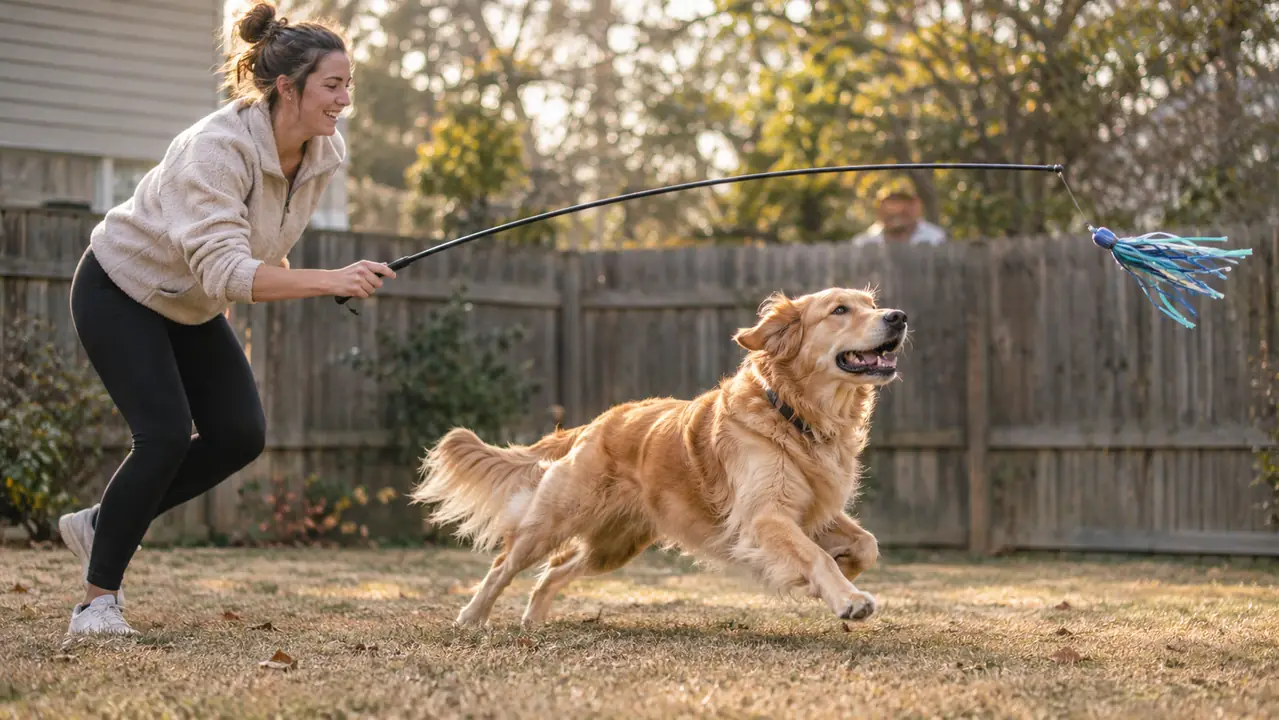
Juno does not have an off switch. She is a 4-year-old Border Collie, about 40 pounds, and if I let her she will chase a ball until her gait goes flat and her back end starts swinging wide. I found that out two winters ago on a foothill trail outside Boise, and I have been managing her output ever since. Walking her does almost nothing. She needs to sprint, plant, turn, and stop, and she needs it in short bursts instead of one long grind. That distinction is the whole reason I bought a flirt pole.
The model I have is the Squishy Face Studio Flirt Pole V2 in the regular 36-inch size. A flirt pole is a teaser wand with a lure on the end. You move it, the dog chases it, and the dog does more honest physical work in eight minutes than in a 45-minute leash walk. I have run this one through mud, frost, and a great deal of dry cheatgrass. Some parts impressed me. One part annoys me every single time I use it. Here is the honest version.
The Quick Verdict
The best short-session outlet I have found for a high-drive dog. Light, easy to swing one-handed, and it genuinely tires her out. It is not water resistant and it will not install an off switch, but on build and function it earns its spot by the back door.
Amazon Check Today's Price →Ten minutes of chasing beats a 45-minute walk
The Flirt Pole V2 is 36 inches, 12.8 ounces, and ships with the lure included. If your dog needs a real outlet instead of a longer stroll, start here.
Amazon Check Today's Price on Amazon →How I've Used It
I keep it by the back door and use it three or four times a week, almost always in the fenced backyard. The routine is boring on purpose. Two or three rounds of two to three minutes each, with a real pause between rounds so Juno's breathing comes back down. Then we finish with a slow walk around the block and a drink. That is the whole session, and it takes under fifteen minutes including the cooldown.
The other place it earns its keep is the agility club field. When we are working on turns and deceleration, I can use the lure to load the same muscles without running a full course. I also throw it in the hatchback on trailhead days, because it is light enough that I forget it is in the car until I need it. It has been dropped on gravel, dragged through wet grass, and swung badly by me on more occasions than I want to admit.
I have also started using it as a warm-up before a training session. Three minutes of chasing gets Juno's heart rate up and gets her brain into work mode, which makes the following ten minutes of stays and recalls much sharper than if I had pulled her straight out of the car and asked for attention. That was not the reason I bought it. It has turned out to be the reason it lives in the car now.
One note on the setting. I do not use it on hot pavement or in the middle of the afternoon in July. Juno will chase through heat without complaint, which is exactly the problem with a dog like this. Early morning, or after the sun drops behind the foothills, always. The pole does not care about temperature. The dog does, and I am the one who has to make that call for her.
What the Flirt Pole V2 Actually Is
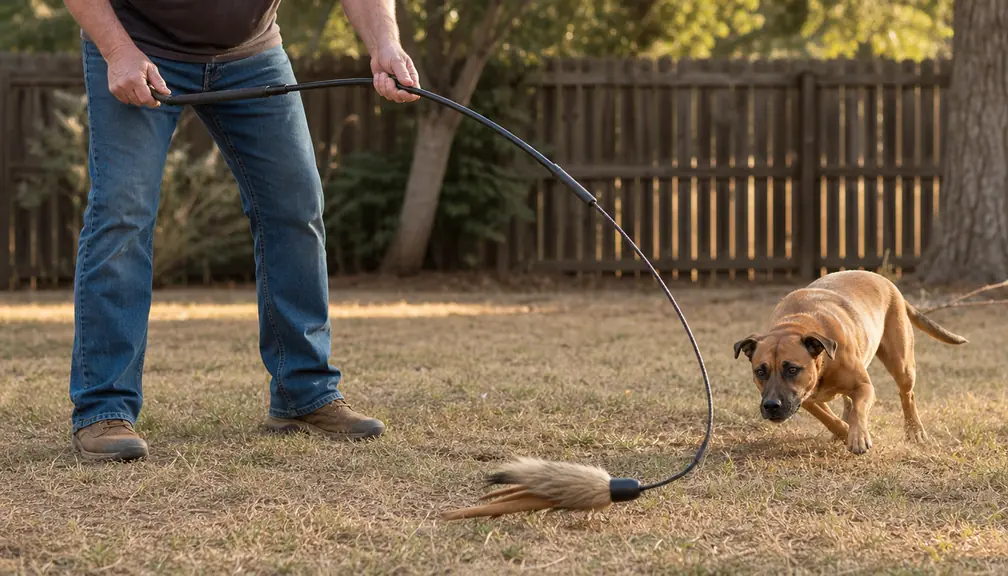
Stripped down, it is a 36-inch teaser wand that weighs 12.8 ounces and ships with a lure. Squishy Face Studio lists the dimensions as 36 by 1.5 by 1 inches, so you get a long reach and a slim profile. The material is polyester. It is made in the USA and it is built around a soft, non-slip grip meant to stay put in a sweaty hand. The listing rates it for all breed sizes, though the dog breed size field says small, which is worth reading twice if you have a very large dog.
The 36-inch length is the part that matters most in practice. It keeps my hand outside the dog's turning radius, so Juno can whip past me at full speed without clipping my knee. When I have used shorter wands, I end up shuffling backward and getting stepped on. The reach here means I can stand mostly still and let the lure do the work, which also keeps my own movement quiet and makes the game easier to control.
The weight is the other quiet win. At 12.8 ounces it is light enough that I can swing it one-handed while holding a leash in the other, and my shoulder is not wrecked after a session. I have swung heavier poles at a friend's house and felt it in my forearm by round three. This one I can hand to a beginner and they can keep it going for ten minutes without their grip failing first.
In the box you get the pole and the lure, and that is it. No straps, no spare lure, no bag. I hung a small hook by the back door and that has been the entire storage solution. If you are the kind of person who needs a designated place for things or they vanish into the garage forever, plan that spot before the pole arrives.
What Ten Minutes Does to a High-Drive Dog
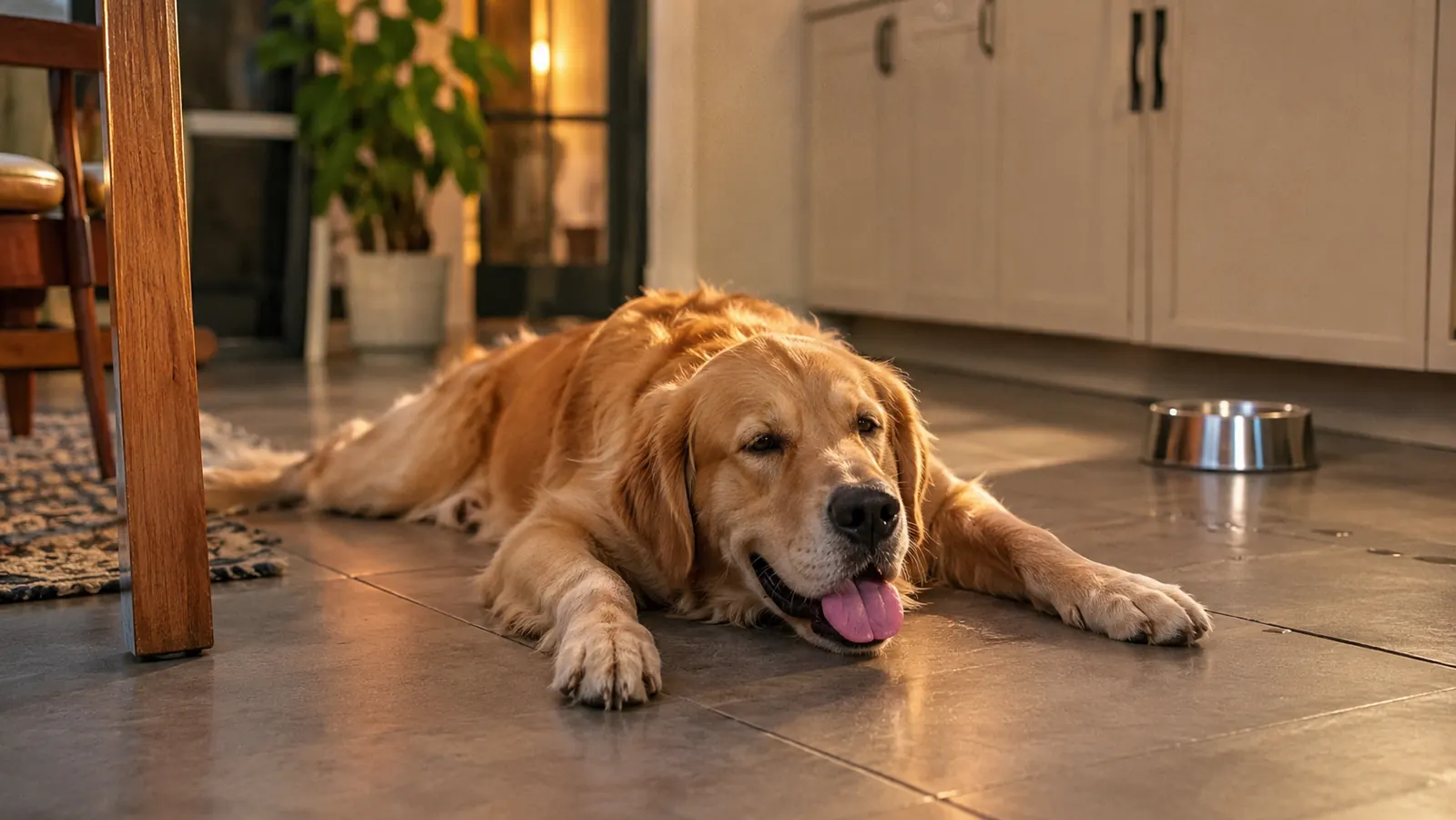
Here is the part that convinced me. After two rounds, Juno's tongue is out and she is offering a down without being asked. After a third round she is done, actually done, and she sleeps through dinner prep instead of pacing the kitchen. No leash walk has ever produced that. Chasing a lure is not steady-state work. It is sprint, plant, cut, sprint again, which is closer to what she does when she is working stock than anything I can replicate on a sidewalk.
I have measured this in the only way that matters to me, which is how she moves the next morning. After a pole session she trots out of the crate loose and even. After a long ball session she is stiff through the lower back for a day. That is not a scientific finding. It is one dog and one owner paying attention. But it changed how I structure her week, and it is why the ball is now a weekend thing.
The catch is that this kind of work is expensive for joints and paws. Hard turns on dry grass are fine. Hard turns on wet clay or frozen ground are how cruciate injuries happen, so I check the footing before I start. I also cap it. A high-drive dog will not tell you when to stop, so I count rounds out loud and stop on the count, not on her body language. Ten minutes of honest work, then a cooldown.
Two rounds and Juno is offering a down without being asked. Three rounds and she sleeps through dinner prep. No leash walk has ever done that.
Flirt Pole vs. Fetch, and Why I Split the Difference
Fetch is easier. You throw, the dog runs, you check your phone. The problem with fetch for a dog like Juno is that it is mostly straight-line sprinting off one explosive start, and the stop at the end of the retrieve is the hardest part of the whole rep. Do forty of those and you have loaded the same joints in the same direction forty times. A flirt pole spreads the load across cuts, turns, and direction changes, and I control the tempo instead of the dog.
I still throw a ball. Fetch is useful for a dog that needs to open up and run flat out, and it is the easier game to play when I am tired. But I have moved roughly half of our weekday sessions to the pole, because I can end it in ten minutes and I can end it on my terms. That control is worth more to me than the convenience of standing still.
The Build: What Held Up and What I'd Change
After a season of use with the Squishy Face Studio pole, the grip is the part I trust most. It stays put even when my hands are wet or I am wearing light gloves, and it has not gone slick or tacky. The pole itself has taken knocks against fence posts and the gravel driveway without cracking. The lure shows the wear you would expect from polyester dragged across rough ground. The edges fray. That is normal, not a defect.
The one genuine annoyance is the water resistance rating, which is listed as not water resistant. That is honest labeling and I appreciate it, but it means wet grass mornings leave the lure damp and I have to dry it before I put it away. Left in a damp corner of the garage it stays damp. A two-second wipe fixes it. I just had to build the habit.
The other thing I would flag is not the pole's fault at all. The dog can win the lure if you let them. That is handler error, and it happens when you are tired and you drop the lure into the dog's mouth instead of pulling it away. Once Juno catches it, the game is over and she knows it. So the lure lives on a hook by the door, not on the floor, and I end every session by putting it away instead of letting her carry it around the yard.
What I Liked
- 12.8 ounces, so it is easy to swing one-handed for a full session
- 36-inch reach keeps your hand clear of a dog cutting at full speed
- Soft, non-slip grip that stays usable with wet or sweaty hands
- Lure included, made in the USA, and it survived a full season of yard use
- Produces real fatigue in under ten minutes, which shortens the whole session
Where It Falls Short
- Rated not water resistant, so wet grass means drying it before storage
- The lure frays with rough-ground use and is the part that wears first
- Nothing stops the dog from catching the lure if the handler is slow
- Listed dog breed size is small, so very large dogs deserve a second look
- It is a handling tool, not a babysitter. You cannot leave a dog alone with it
Handling, Grip, and the 12.8-Ounce Question
Most of the value of this thing is in your wrist and your timing, not in the product. The move that works for us is a low, skimming drag across the grass with sharp direction changes, then a pause. The pause is what makes it good exercise, because Juno has to decelerate and re-accelerate instead of running a smooth arc. A smooth arc is easy. A cut and a restart is work.
One more handling note that took me a while to learn. Keep the pole low. New handlers tend to hold it up and swing it like a fishing rod, which puts the lure in the air and encourages the dog to jump and twist. Jumping and twisting is exactly the motion I want to avoid with a dog that already turns hard. Low, skimming, ground-level movement keeps the dog's feet under them.
If you have never used one, the learning curve is about three sessions. The first session you will over-swing. The second you will catch the dog's teeth on the lure by accident. By the third you will have worked out that small movements are better than big ones, and that the pole does the reaching so you do not have to. I would not hand one to a kid and walk away.
Who This Is For
This suits the owner of a dog that is physically sound, mentally busy, and not tired out by walking. Herding breeds, terrier mixes, sporting dogs, and any dog that stares at you at six in the morning. It suits someone with a small yard, because 36 inches of reach and eight minutes of chasing fits in a space far smaller than a dog needs to fetch. It also suits the person who wants a training tool rather than a toy, since the same lure can be used to reward a recall or a stay.
Who Should Skip It
Skip it if your dog has a recent soft tissue or cruciate injury, or if your vet has told you to limit sharp turns. Skip it if your dog guards toys, because a lure that gets grabbed and held creates exactly the standoff you do not want. Skip it if you want to put the dog outside with a toy and go back to your desk, because this needs a person on the other end. And skip it if you cannot commit to stopping the session on your count rather than the dog's.
If your dog needs a job, give them one that fits in the backyard
36 inches, 12.8 ounces, lure included, and a session that finishes in under ten minutes. Clear the footing first, count your rounds out loud, then let your dog work.
Amazon Check Today's Price on Amazon →