
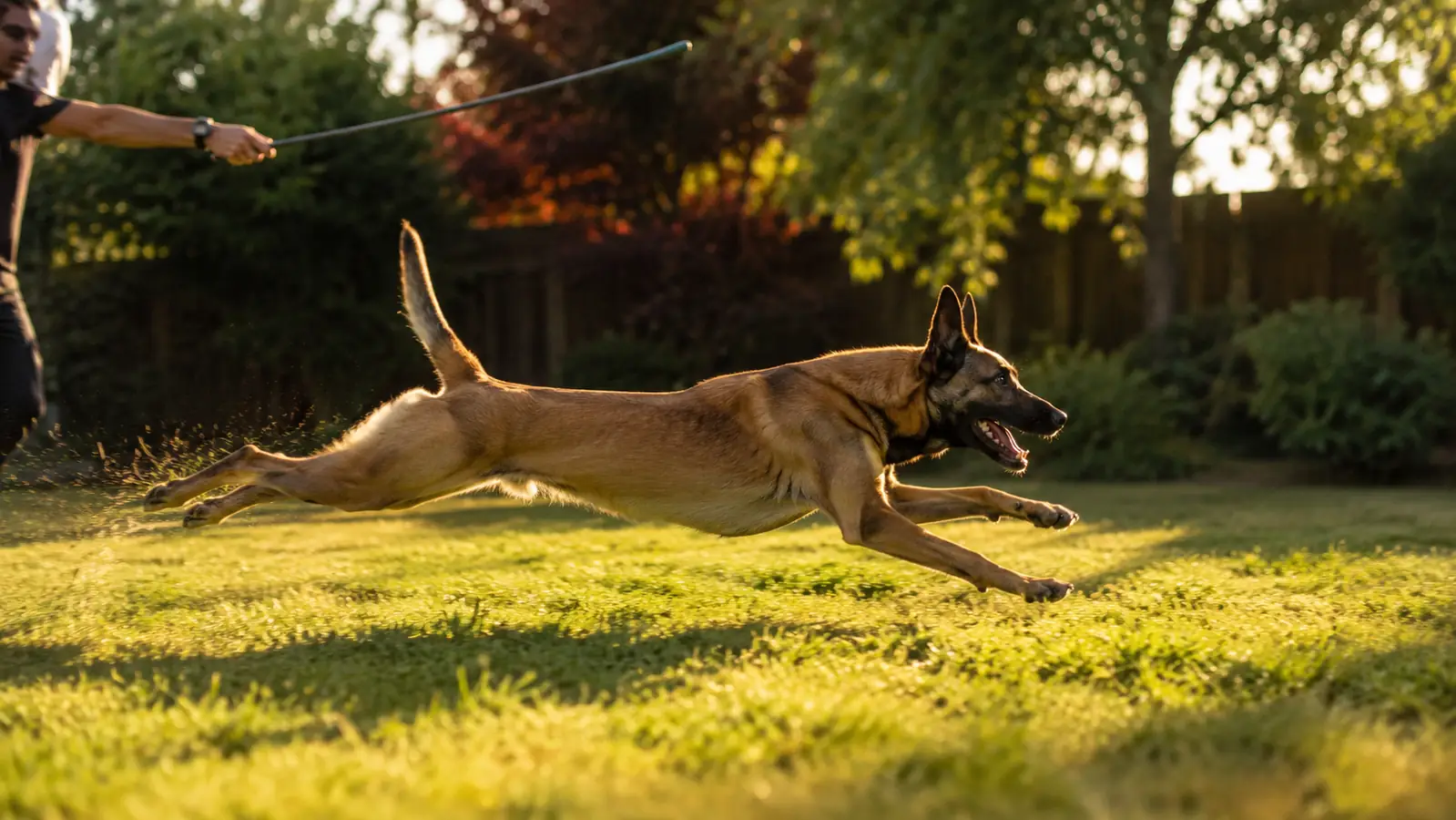
Juno will chase anything I move fast. That is the reason I own a flirt pole, and it is also the reason I nearly wrecked her knees with one. The first time I took a lure wand into my backyard outside Boise, I whipped it in wide circles at full speed for six or seven minutes, let her spin like a top, and called that exercise. She slept hard for two hours and then came up lame on the leg she had been pivoting on. Nothing was torn. But the tech at my vet clinic gave me a look I have not forgotten, and I rebuilt the way I use the thing from the ground up. What follows is the rebuilt version, the one I now use three or four days a week with a four-year-old Border Collie who would run herself into the dirt if I let her.
A flirt pole is a teaser wand, the same idea as a cat toy scaled up for a dog. The Squishy Face Studio Flirt Pole V2 is a 36 inch pole with a lure on the end, 12.8 ounces total, which is under a pound in your hand. It has a soft, non-slip grip, it is made in the USA, and the listing pitches it as a way to get a real workout in under ten minutes a day by tapping into a dog's prey drive. All of that is accurate. None of it is the part that matters most. What matters is that this tool lets a dog accelerate, cut, decelerate and stop harder than anything else I have handed a dog, and a dog doing that at full speed puts load through shoulders, wrists and knees. Used well, that is conditioning. Used carelessly, it is a repetitive strain injury on a string.
Built to Be Held With One Hand While the Other End Runs
The Squishy Face Studio Flirt Pole V2 is a 36 inch teaser wand, 12.8 ounces, with a soft non-slip grip and a lure light enough to move like prey. Every step below assumes you have one in your hand.
Amazon Check Today's Price on Amazon →Step 1: Clear the Space and Check the Ground
A flirt pole is not a living room toy, and it is not a gravel driveway toy either. I want a rectangle of grass or turf about 20 by 30 feet, with nothing to trip over and enough room for a dog to run a straight line of ten or twelve strides before it turns. Juno's straight line speed is the whole point of the exercise, and a straight line needs room. If your yard is smaller than that, go to a park or a fenced school field at an off hour. What you cannot do is run this in a hallway or on a slick patio, because a dog at full speed on a hard slick surface has no way to stop.
Then walk the ground. I do this barefoot so I can feel what she will feel: divots, a hose, a rock the mower threw, the edge of a paver, the stump I keep forgetting about. Turn over anything loose. In summer I also check the surface temperature with the back of my hand before we start, because turf and asphalt hold heat long after the air cools. One more thing specific to this pole: Squishy Face Studio states it is not water resistant, so wet morning grass and a pole left out overnight are how you shorten its life. I wipe mine down and hang it in the garage, and I keep the lure off the damp ground.
Step 2: Warm the Dog Up Before You Ask for Speed
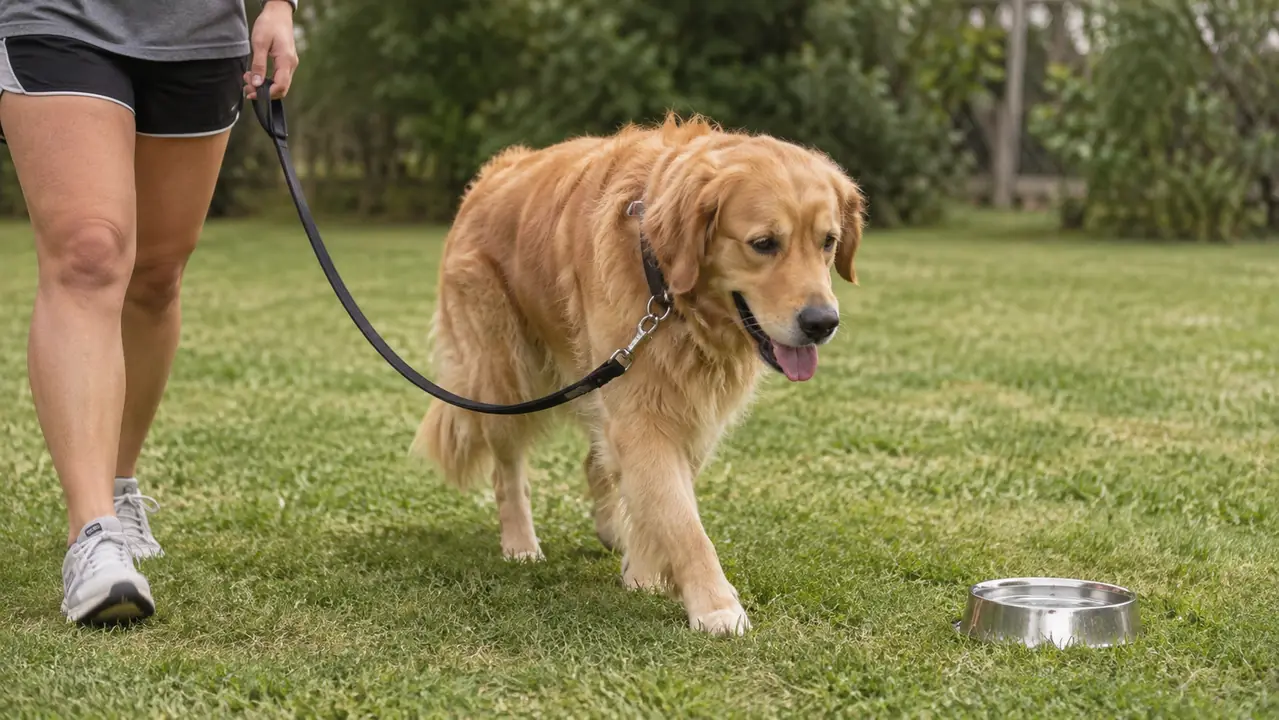
This is the step almost everyone skips, and it is the step I now refuse to skip. A cold dog asked to sprint and cut is a dog asking its soft tissue to do work it has not been prepared for. Five minutes of brisk walking on a loose leash, a few easy sits and downs, a couple of slow figure eights around my legs, and a hand target or two to get her thinking about me instead of the lure. That is the whole warm up. It is not complicated and it costs almost nothing.
I also check her paws and nails before we begin. Long nails change how a dog's foot lands, which matters a great deal when the dog is braking hard on grass. If her pads are dry and cracked from a dry Idaho summer, I shorten the session or skip it entirely. And if your dog is still growing, talk to your vet before you introduce a flirt pole at all. Growth plates in a young dog are not the same tissue as an adult's, and the tight turns this game produces are exactly the kind of load that conversation is about. I did not start Juno on a lure wand until she was past two, and I would make the same call again.
Step 3: Move the Lure Like Prey, Not Like a Toy on a String
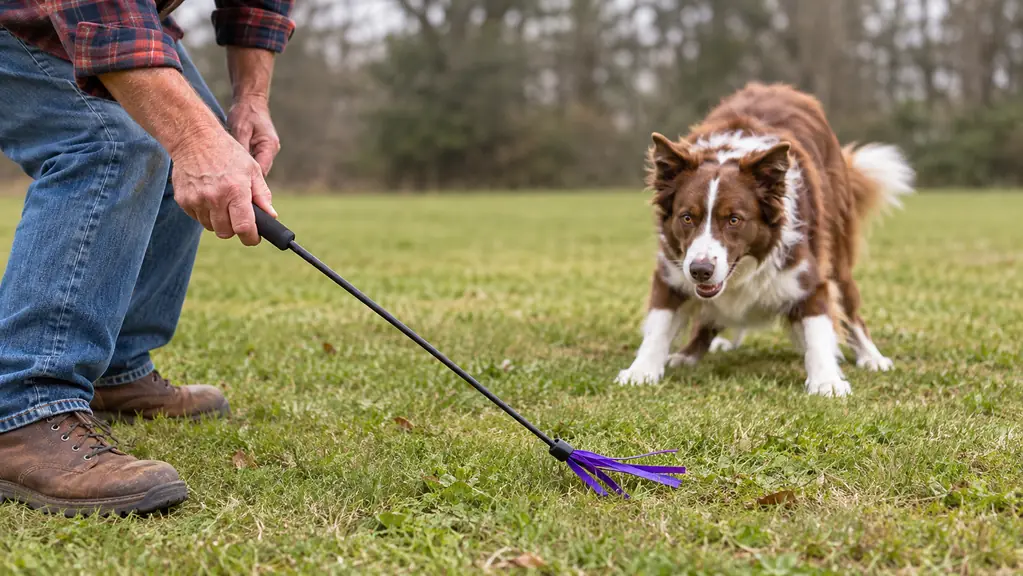
The mistake I made first is the one I see most often: holding the pole high and swinging the lure in fast circles overhead. That makes a dog spin, and spinning is the single worst thing a flirt pole can teach. Prey does not orbit. Prey bolts in a line, freezes, then bolts again. So I keep the tip of the pole low, near the ground, and I move the lure in short escapes of three or four feet, pause, then another escape in a slightly different direction. The dog gets to accelerate in a straight line, gather, turn, and accelerate again, which is a better workout than a tight circle and much easier on the joints.
I also control how often Juno actually catches the lure. If she never wins, she stops trying and the game loses its value. If she wins every time, she learns to grab rather than chase. My rough rule is that she gets the lure maybe one time in four, and always on my cue, which brings me to the next step. Two to four minutes of that, then a break. That is one set. Three sets is a full session for a dog of her drive, and the twenty minute mark is where I stop no matter how much she wants to keep going.
Step 4: Teach the Out and the Stop Before You Teach the Sprint
The impulse control part of a flirt pole is not a bonus. It is the reason the tool earns its place in my training bag. A dog that can watch a lure move at speed and hold position until released is a dog learning something that transfers directly to agility start lines, canicross starts and the front door. So I practice the boring version first: lure held still on the ground, dog on a leash, I cue a wait, and I reward the wait with a release to grab. Ten reps of that before we ever run.
The out matters just as much. I build a trade, meaning the lure goes limp, I put a treat to her nose, and she releases the fabric to take the treat. Then I put the release on a name. For Juno the cue is out. I practice it when she is barely excited, not when she is at the top of her drive, and I pay well every single time. A dog that will not release a lure is a dog you cannot safely play this game with, because the release is what lets you reset the session and check the dog over. If your dog will not out yet, work on that with a still lure and a long line before you add any speed at all.
Step 5: Cap the Session and Cool the Dog Down on Purpose
The listing says this tool can deliver a workout in under ten minutes a day, and after three years of using one I think that is closer to correct than most people expect. Ten minutes of real chasing is a lot of work. My sessions are five to eight minutes of actual movement with breaks built in, and I stop while Juno still wants more. That last part is deliberate. Ending on a high, with the pole going away into the garage while she is still tugging toward it, is what keeps the game valuable and keeps her from learning to be frantic about it.
Then I cool her down instead of just letting her collapse. Two or three minutes of walking on a loose leash, a drink, and a slow check: pads, nails, shoulders, and a hand run down each back leg. Heat is the other half of this. A high-drive dog in an Idaho July will not stop herself, so I do flirt pole work early in the morning or after the sun drops behind the foothills, and I keep water in the shade. If she is panting hard with a wide flat tongue, we are done, and that is not a negotiation.
What Else Helps
The pole is one piece of a bigger picture, and I would be lying if I said the tool alone fixed anything. Juno gets real walks, a couple of structured training sessions a week, and time on the agility club field. The flirt pole is what I reach for on the days when I have fifteen minutes and she has a full tank, and it is what I use to sharpen a stop or a start. It also pairs well with a mat and a settle cue, because the fastest way to build impulse control is to alternate high arousal with a clear off switch. Chase for ninety seconds, then mat for sixty. Repeat. That contrast does more for her than either half alone.
What this thing does not do is worth saying plainly. The pole is not water resistant, so it is a fair weather and dry grass tool. The lure is fabric on the end of a line, and fabric wears, so expect to replace it eventually. The Regular 36 inch size is the one I use and it suits my height and Juno's size, but a very tall handler may find it short. And the biggest caveat is not about the gear at all: this game can tip a dog into prey drive hard enough that they redirect onto the person holding the pole. If your dog gets mouthy at the end of a session, you need a barrier, a long line, or a trainer, not a longer pole. The Squishy Face Studio Flirt Pole V2 is well made and easy to handle one handed, and it still cannot make up for a handler who moves too fast too soon.
Two groups should handle this carefully. Dogs with a known joint issue, or dogs coming back from a soft tissue injury, need a vet or a rehab professional to sign off on tight turns and hard stops before a lure comes out. Puppies need to wait, for the growth plate reason above. Everyone else can start tonight with a clear patch of grass, five minutes of walking, and a lure moved low and slow.
Two to four minutes of real chasing does more for Juno's impulse control than twenty minutes of fetch, because fetch rewards the sprint and the flirt pole rewards the stop.
Ten Minutes a Day, and a Dog Who Can Stop on Command
If you are going to run this game, run it with a tool built to be handled one handed: 36 inches, 12.8 ounces, soft non-slip grip, made in the USA. Then follow the five steps above, in order.
Amazon Check Today's Price on Amazon →